
I've been considering lore and storyline a lot lately while I script, and one of the things I keep returning to is creating compelling conflict in the world. There's several things to keep in mind while creating conflict for S&S.
First, I want the conflict to be realistic. In the real world, though we like to think in terms of good guys vs. bad guys (we Americans are especially notorious for this), conflict is complicated. There are heroes and villains on both sides of every conflict and, though history is generally written by the victors, there's no "right side" in realistic conflicts.
From the beginning, one of the guiding principles of Shadows & Silver has been that there would be no overarching good vs. evil conflict, so it doesn't work to have traditional goblin raiders or the dragon that terrorizes the countryside. Rather, who you root for will depend on your perspective. A good example here is the War of Burdean Sovereignty. From the perspective of Burdeans, Burdea's sovereignty was more important than the political unity of Adunay. The belief in the ability of small states to govern themselves compelled them to action against what they perceived to be an oppressive regime. This is contrasted by the other Adunean states, which believed the strength of a united Adunay was more important than the rights of any individual state. As a character in the world, your viewpoint likely comes down to whether you see yourself as a citizen of Adunay or of your state. Burdeans, for example, are fiercely protective of their independence, and see themselves as Burdeans first and Aduneans second.
Burdea versus Adunay is a representation of the conflict of political identity, but also of security versus liberty. Most soldiers on either side of the war did not sit down to think about where they stood on the individual issues. Rather, the source of their national pride determined how they reacted to the different conflicts the War created.
Second, history is not linear, not just a series of events. Rather, it is a complex web of ideas, actions, and consequences. The effects of any action can be felt across the centuries, just as a butterfly beating its wings in the Pacific causes a hurricane in Florida. It's the way of the world, and the way of a realistic setting.
In S&S, the war with Burdea had consequences that continue to this day. For one, it caused unrest and political dissent in the populace at large on both sides. Social upheaval became a daily occurrence. The infighting also weakened the security of Adunay, making it vulnerable to those both within and without. The old monarchies fought for control even as the coalition devolved into chaos. In reaction to that, a wave of conquests swept Adunay, culminating in the establishment of an Adunean Empire ruled by martial law. Power and wealth lead the Empire to attack its neighbors, and the resulting war with the northern Krunags led to the Empire's fall, once again plunging the land into chaos. Today, though the Confederation has nominally established control over Adunay, but the revolutions continue. Hundreds of factions pull the government this way and that, others seek its downfall entirely.
Thirdly, it's important for the players to have lots of adversaries, but no real villain. Even if the PCs were to put aside their differences and pursue a common goal (how unrealistic is that?), there shouldn't be a Big Bad Evil Guy™ to focus on. Remember, conflict is not found in bad guys; it's found in ideas you oppose.
For a real world example, consider the Palestinian vs. Israel conflict. The conflict is not between people but between ideas. It's not a good guys versus bad guys conflict or a terrorists versus democracy conflict. It's not Hamas versus Mossad. It's one ethnic group's nationalism versus another group's nationalism. It's an idea versus an idea. So, while the idea you support has opponents, there is no "bad guy" to focus your attention on. To win the conflict, you have to unseat an idea, not a leader.
In S&S, a similar conflict can be found in the colonization of former Nerath by the Aduneans and Salicians. These countries see themselves as bringing civilization to the backwards people of the eastern Plain, and they inevitably find themselves in conflict with the native peoples, who don't take kindly to being treated like the scum of the earth. The real conflict here is in the ideas. The West believes that, because of its technological superiority, it has the right to the resources of the East, and that spreading their civilization to them and ridding them of the "Brown Menace" is more than payment. The East believes its ways are its own, regardless of any technical inferiority, and that its lands are not open for exploitation by Western powers.
Finally, conflict exists independently of the PCs. It's not there so the PCs have something to fix. It's there because that's the way things are. If the PCs want to jump in and try to fix things, great. But if their shortsightedness simply messes things up more, even better. National and ethnic conflict is not easily settled, especially when it has lasted for centuries, and creating the illusion of true conflict within the game world requires a lot of forethought.
Think about the role you want conflict to play in your setting. Do you want bad guys versus good guys, or do you want something more fluid, more dynamic? How do you plan to complicate things? Do you want to try to teach the players a lesson as they unravel conflicts into their component ideas? Or do you want a sort of sandbox for them to deal with real-world conflicts within the game?
For those of you participating in S&S, what conflicts would you like to see played out? Most interested here in conflicts of ideas as listed above, but perhaps you have ideas for various factions that might vie against each other?
Showing posts with label complication. Show all posts
Showing posts with label complication. Show all posts
Tuesday, July 28, 2009

Saturday, May 2, 2009
Slow progress
Hey there, Sherincall here with our progress report.
Progress has been really slow this month due to a very busy life we're forced to deal with. However, it is not right to say we haven't been productive. On the contrary, we keep getting new ideas, really cool ones too. Unfortunately, that results in a much bigger to do list. Anyway, what has been done (or almost done) is a very nice ambient system (Squatting Monk) and a mana based spellcasting system (Sherincall). Here's a list of script systems taken from a 'Builder's Guide' I'm working on.
Finished systems:
In the works:
To Do:
There is light at the end of the tunnel, though. Starting June 5th, I'll have a few more hours per day for scripting, and starting July 5th, I'll have a few more.. About 8. My estimate is that by August all scripting will be done.
Apart from scripting, the other thing that requires a lot of time is custom content. Placeables are done, though a bit outdated (we'll need to look at the stuff that was released in the past month). Tilesets are half-way done. The other half will require a skilled modeler. We also have a ruleset base, which we'll build upon. I estimate the haks will be completed sometime mid August.
After that, it's building till we drop.
Umec does not have a family. He seems completely emotionless, caring only about profit. The truth is that he has become obsessed with a relic he had acquired. A book that belonged to a powerful alchemist, a book he believes holds many secrets known to very few men. He has been studying it for years, yet hasn't been able to decipher and understand the writings contained within.
Umec is not an irrational person, he is well aware of the dangers he is putting himself into. He will never act prematurely, and always carefully calculates everything before making a decision. Ever since his retirement from adventuring, he has not failed in anything. His prosperity is slow but certain.
Despite being a professional killer, Anna is not without morals and codes. She has a perverted sense of loyalty, and considers betrayal worse than anything. She will cruelly punish anyone who betrays anyone, even her enemies. She dislikes pointless killing, and will always avoid ending a life unless necessary. This does not mean that she will forfeit an assignment she has been given. If she has been hired to kill a man, she will not stop until one of them is dead. It is not uncommon for Anna to give charity and help other people, especially children.
Sarah is the daughter of an elven priestess and one of their nobles. After her father has done some very wicked things, both him and Sarah were exiled. Sarah later killed her abusive father during their visit to Midport and tried to survive on her own. She thrived on the streets, and rose high in the ranks of a guild. The leaders of that guild thought her to be a threat and tried to eliminate her. She viciously punished all who were involved in that betrayal and with the remaining members founded the Purple Masks.
-------------------------------------------
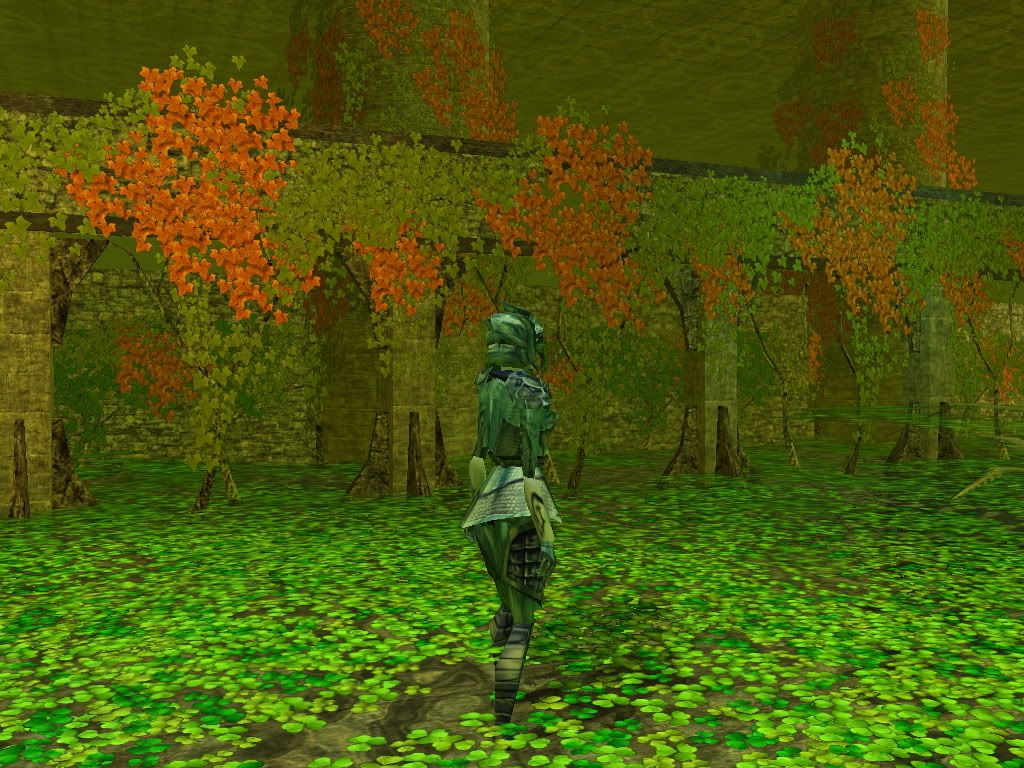
I don't have any new screenshots to show, so here's an old one, to break the monotony.
Progress has been really slow this month due to a very busy life we're forced to deal with. However, it is not right to say we haven't been productive. On the contrary, we keep getting new ideas, really cool ones too. Unfortunately, that results in a much bigger to do list. Anyway, what has been done (or almost done) is a very nice ambient system (Squatting Monk) and a mana based spellcasting system (Sherincall). Here's a list of script systems taken from a 'Builder's Guide' I'm working on.
Finished systems:
- Core Framework (SS) - Authors: Edward Beck, Squatting Monk
- Generic System (G) - Authors: Squatting Monk, Sherincall
- Persistent Reputation and Reaction System (PRR) - Authors: Vendalus, Squatting Monk
- Experience System (XP) - Authors: Squatting Monk, Knat
- Spawn System (SP) - Author: Sherincall
- Persistent Storage Chests (PSC) - Authors: HerMyT, Sherincall, Squatting Monk
- Persistent Quests & Journals (PQJ) - Author: Squatting Monk
- Hunger, Thirst and Fatigue (HTF) - Authors: Edward Beck, Squatting Monk
- Chat Control System (CHAT) - Author: Sherincall
- Rest System (REST) - Authors: Edward Beck, Squatting Monk
- Bleeding and Death (BD) - Authors: Edward Beck, Squatting Monk
- Visual Effects System (VFX) - Authors: Sunjammer, gaoneng, Sherincall
- Cutscene System (CS) - Author: John "Gestalt" Bye
- Dynamic Dialog System (DLG) - Authors: Paul Speed, Greyhawk0, Sherincall
In the works:
- Ambient System - Squatting Monk
- Spellcasting System - Sherincall
To Do:
- Inn System
- Horses and Pack Animals
- Crafting and Alchemy
- Bulletin Boards and Newspapers
- Custom AI
- Player and DM Tools
- Weather System
There is light at the end of the tunnel, though. Starting June 5th, I'll have a few more hours per day for scripting, and starting July 5th, I'll have a few more.. About 8. My estimate is that by August all scripting will be done.
Apart from scripting, the other thing that requires a lot of time is custom content. Placeables are done, though a bit outdated (we'll need to look at the stuff that was released in the past month). Tilesets are half-way done. The other half will require a skilled modeler. We also have a ruleset base, which we'll build upon. I estimate the haks will be completed sometime mid August.
After that, it's building till we drop.
-------------------------------------------
In other news, we have a few more enthusiastic people helping us (A big round of applause for Ociros and Esayitch). Though they are busy as well, more people means more progress. It will all change soon, I'm certain.-------------------------------------------
And finally, some lore (Pardon my poor narative skills.)
And finally, some lore (Pardon my poor narative skills.)
Umec Adkal
Umec is a respected noble of Midport. In his early days he was a famous warrior and adventurer, before he got crippled. Now, in his early 40s, Umec is a successful merchant, dealing in exotic trinkets. He is the employer of the Purple Masks, an assassin squad he uses to get rid of his enemies and aquire valuable trinkets.Umec does not have a family. He seems completely emotionless, caring only about profit. The truth is that he has become obsessed with a relic he had acquired. A book that belonged to a powerful alchemist, a book he believes holds many secrets known to very few men. He has been studying it for years, yet hasn't been able to decipher and understand the writings contained within.
Umec is not an irrational person, he is well aware of the dangers he is putting himself into. He will never act prematurely, and always carefully calculates everything before making a decision. Ever since his retirement from adventuring, he has not failed in anything. His prosperity is slow but certain.
Anna
People who know her true name, Sarah Sol'Dath, are very rare, and often get even rarer once she finds one of them. Anna is possibly the deadliest of assassins in Midport. She is currently working for one of the nobles, Umec Adkal, who has given her a place in his mansion to use as headquarters for her squad known as the Purple Masks.Despite being a professional killer, Anna is not without morals and codes. She has a perverted sense of loyalty, and considers betrayal worse than anything. She will cruelly punish anyone who betrays anyone, even her enemies. She dislikes pointless killing, and will always avoid ending a life unless necessary. This does not mean that she will forfeit an assignment she has been given. If she has been hired to kill a man, she will not stop until one of them is dead. It is not uncommon for Anna to give charity and help other people, especially children.
Sarah is the daughter of an elven priestess and one of their nobles. After her father has done some very wicked things, both him and Sarah were exiled. Sarah later killed her abusive father during their visit to Midport and tried to survive on her own. She thrived on the streets, and rose high in the ranks of a guild. The leaders of that guild thought her to be a threat and tried to eliminate her. She viciously punished all who were involved in that betrayal and with the remaining members founded the Purple Masks.
-------------------------------------------
I don't have any new screenshots to show, so here's an old one, to break the monotony.
Thursday, March 27, 2008
Plot, Part 1
Whether you have a theme you wish to communicate in your work or not, all stories have some sort of conflict at their center. Such conflict can be external or internal. External conflict is the most common and usually takes the form of the protagonist versus an antagonist. For example, the novel Night Watch, by Terry Pratchett, pits Commander Sam Vimes against the insane criminal Carcer Dun. Internal conflicts deal with the protagonist versus himself. A good example is Anakin Skywalker's internal struggle between the Light Side and the Dark Side in Star Wars. Often, stories have both internal and external conflicts. In The Old Man and the Sea, Santiago battles with the marlin (external) as well as with his own desire to give up his chase and rest (internal). Regardless of the type of conflict, stories always contain them.
Stories also frequently contain complications. If the story had no complications, the protagonist could waltz right through it, easily solving the conflicts. Night Watch has Commander Vimes vaulted back into the past and has to be careful not to cause paradox when he meets his younger self. To top it off, Carcer (who has also been transported back) allies himself with those who are plotting to overthrow the government, a conflict that, historically, caused much bloodshed in Ankh-Morpork. In Star Wars, Anakin has premonitions of Padmé's death and believes that giving in to the power of the Dark Side is the only way to save her. Frequently, good stories have many complications keeping the protagonist from solving a relatively simple problem. In effect, complications are subconflicts which the protagonist must resolve before dealing with the primary conflict. Sometimes, as with Anakin Skyalker, complications are simply paradoxes pulling the protagonist between extremes (Anakin wants to follow what he knows is right, so he leans towards the Light Side; he also wants to save those close to him, so he leans toward the Dark).
After overcoming complications, the protagonist can then deal with the main conflict. This is called the resolution. The resolution of Night Watch results in Vimes successfully capturing Carcer and averting much of the bloodshed of the revolution. Resolutions are not always happy endings, however. Santiago successfully wins the battles against himself and the marlin, only to lose his catch to sharks and nearly die at sea. Anakin falls to the Dark Side and still loses Padmé, only to be redeemed in the last few moments of his life an ending that, while it could have been worse, was still far from happy.
We'll start working on some plot next time following the formula laid out here: conflict (external or internal) → complications → resolution.
Stories also frequently contain complications. If the story had no complications, the protagonist could waltz right through it, easily solving the conflicts. Night Watch has Commander Vimes vaulted back into the past and has to be careful not to cause paradox when he meets his younger self. To top it off, Carcer (who has also been transported back) allies himself with those who are plotting to overthrow the government, a conflict that, historically, caused much bloodshed in Ankh-Morpork. In Star Wars, Anakin has premonitions of Padmé's death and believes that giving in to the power of the Dark Side is the only way to save her. Frequently, good stories have many complications keeping the protagonist from solving a relatively simple problem. In effect, complications are subconflicts which the protagonist must resolve before dealing with the primary conflict. Sometimes, as with Anakin Skyalker, complications are simply paradoxes pulling the protagonist between extremes (Anakin wants to follow what he knows is right, so he leans towards the Light Side; he also wants to save those close to him, so he leans toward the Dark).
After overcoming complications, the protagonist can then deal with the main conflict. This is called the resolution. The resolution of Night Watch results in Vimes successfully capturing Carcer and averting much of the bloodshed of the revolution. Resolutions are not always happy endings, however. Santiago successfully wins the battles against himself and the marlin, only to lose his catch to sharks and nearly die at sea. Anakin falls to the Dark Side and still loses Padmé, only to be redeemed in the last few moments of his life an ending that, while it could have been worse, was still far from happy.
We'll start working on some plot next time following the formula laid out here: conflict (external or internal) → complications → resolution.
Subscribe to:
Posts (Atom)