Showing posts with label building. Show all posts

Monday, November 3, 2008

Rethinking

Well, it's been a while since my last update. That was due to my getting married (woohoo!) and to computer woes which required me to reinstall Windows twice (still not totally fixed, btw). During that time, I've been turning lots of different ideas for the world over in my head.

One of my ideas is to use Project Q instead of the CEP. Q's content is very high quality, and it matches the slightly gritty TNO art style, which means it will go well with the feel I want in the module. On the other hand, it's still in development, which means it'd be a while until I could incorporate its content into my module. I could just build without it for a while, and I have plenty of script work that could be done during that time. Then, too, the CEP content would have to be ripped out of my module, and that's a lot of work, especially considering how much time it took to place it all so carefully in the first place.

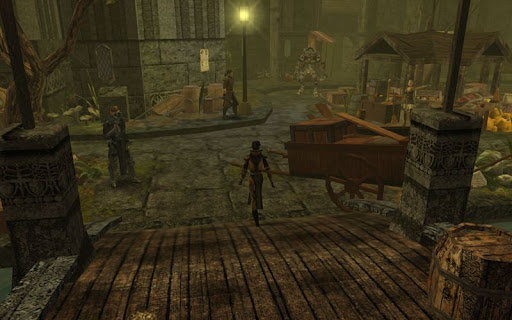
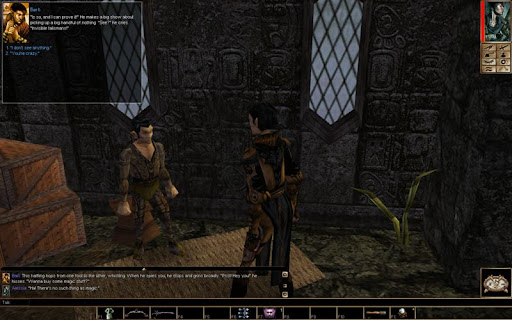
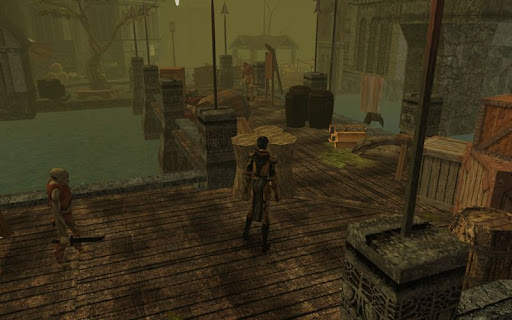
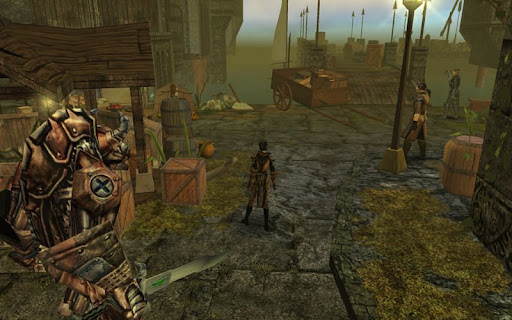
After weighing the options, I think I'll go ahead with my idea and plan to use Q. I'll keep the work I've done untouched so if I decide to go ahead with the CEP instead in the future, I can. I won't be able to do as much building while waiting for the Q content to come out. Wait, no. I will be able to do plenty of building, just not as detailed as I was doing before. That may be good, though. It'll mean I'll get more areas set up, flesh out the city, and possibly even start building some of the countryside and adventure zones. I'll also be able to use the time to work more carefully on storyline and conversations, plan some early DM events, and do all the scripting work I've been putting off.

I suppose getting to rebuild things is good. After all, I've wanted to make some changes to the tileset I've been building Midport with (NWAlleys overwrites the Merchant Ship tile group). Then too, I think I haven't been setting the exact tone I wanted for the module. I wanted it to be a bit for cynical and dark and have a greater presence of technology. As it is, you only get a hint that this isn't just any old medieval port. I want to make things more obvious. I want this world to be truly unique, a place where anyone can come and play and say, "Whoa, I've never seen this before." I think that's why I love the cluttered city look, the NPCs with real personality, the flavor text, and the whole idea of the world. It's something I've never seen before (and I doubt anyone else has). I want it to be a breath of fresh air.

Er, wait... there's no fresh air in Midport. :P

Friday, September 5, 2008

Slow Progress

Wow, it's been a while since I updated. I haven't gotten too terribly much done, but I am still working. Most of my frustration lately has been in trying to get some of my hakpaks to work. Izik the Mad was kind enough to loan me his Giant Eye Skybox for my intro scene. It worked... right up until I tried renaming the model to fit my resource naming scheme. I renamed the texture and went through the model by hand updating the texture references, but it still won't work. Then I started learning Gmax to try to fix things, but that's led to nowhere but frustration. I found some tutorials from the DLA, but they all assume you already know how to model. That makes sense. *grumbles*

Anyway, I've picked the toolset back up in the meantime and am trying to flesh out my city a bit more with some new areas. I've built a few areas and put few or no placeables in the, just so I can get an idea of how the city layout will look. I've also started making some interior areas. I'm mostly just adding the shops that have signs out front, but I'm also making sure I have at least one quest in each one as I firmly believe every place should have something to do. Some of the quests are not availabe right away. You'll have to chat people up and get them to like you before they trust you enough to let you help them. How you do this depends on the person. Merchants like folks that make big purchases, and you can chat with most people to increase their reaction to you. I'm also letting people use the social skills NWN provides to influence each NPC.

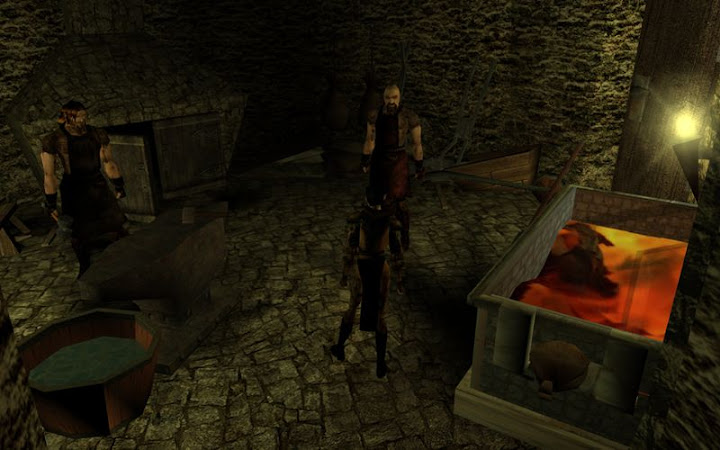
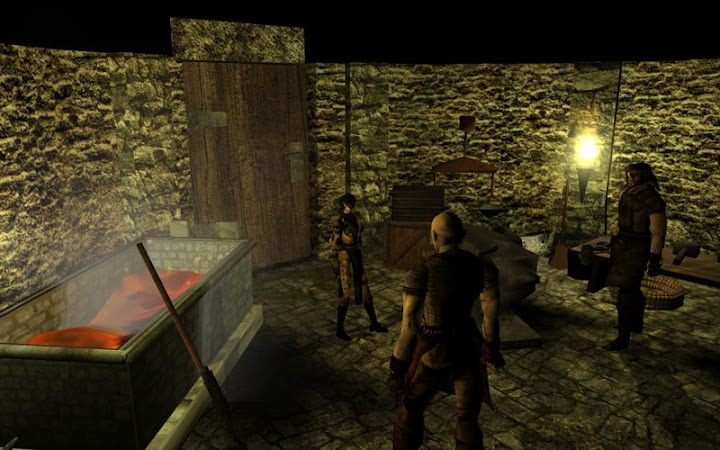
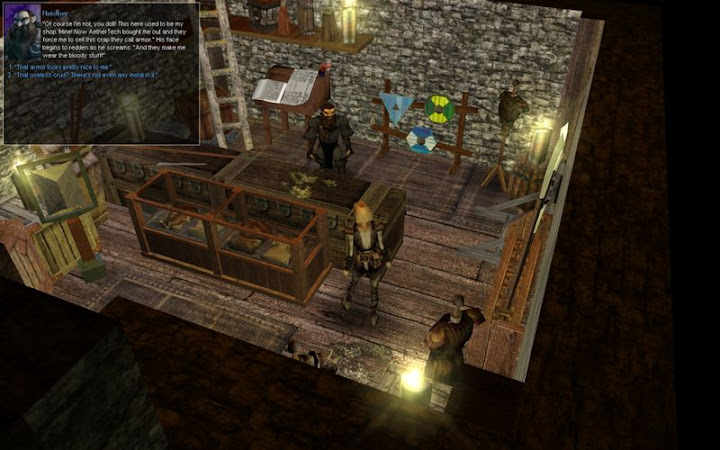
Here's a couple of screenshots of some of the new areas I've created. First, Hollander & Sons. I'll let you guess what they do for a living.


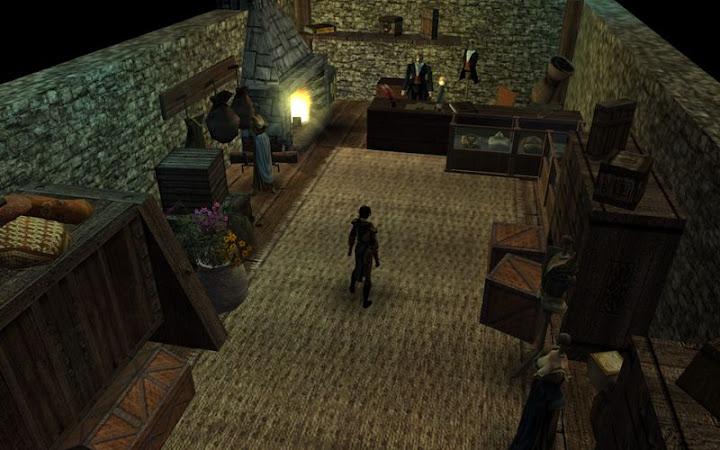
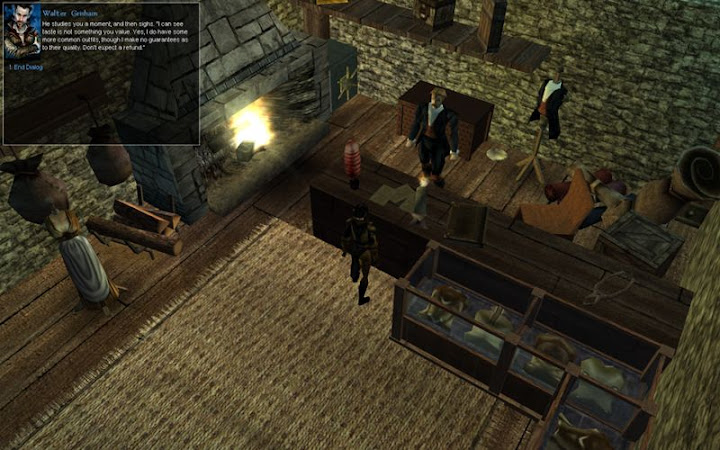
Grisham's Textiles is next. This is where PCs can buy and sell clothes and cloth, as well as a selection of dyes. He doesn't fit in well with the rest of Manheim Court. Perhaps talking to him will dig up some information on why his shop is in such a poor location for one with such fine goods.


Finally, here's Aether Armors, formerly Sundry Armors. When AetherTech Industries bought this shopkeeper out, he got the short end of the stick. He's anxious to get back at them, and patrons that help him could profit... if they don't get caught.


I'm finding interiors easier to design as I go along. They tend not to be as cluttered as the outdoor areas. My thought is that people who own shops tend to keep things more organized than those who cry their wares on the streets. It's also a bit easier to work with sounds, too, since you have less going on indoors than outdoors.

It's coming slowly, but hopefully it'll keep flowing. Enjoy the screenshots!

Wednesday, July 23, 2008

Getting there...

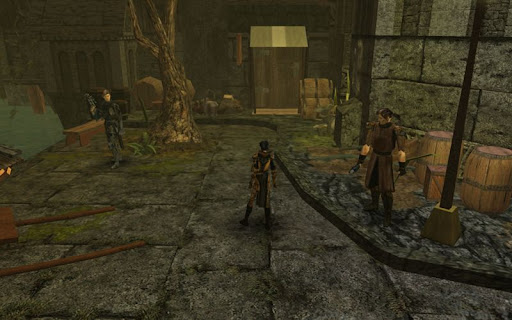
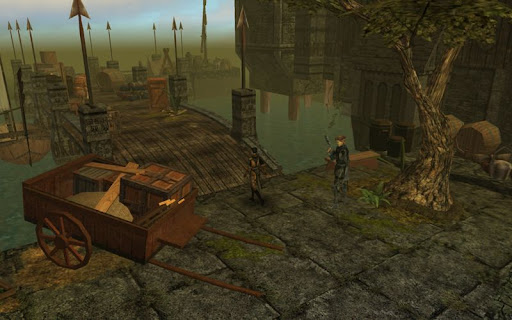
Well, as you can see from the screenshots below, I'm starting to flesh out Manheim Court. Building has been getting easier. The more I do, the less of a struggle it is. I'm starting to find good places to put things and develop an eye for background.


I've also added some story elements into the NPC conversations. I want the world to be immersive, and that means each person should have as much depth to them as possible. Dialog writing takes time, but it's one of the more rewarding parts of building for me.


Seeing dialogs pull the player into the environment helps me see where I'm going with this whole thing. For instance, Errol's complaint of having to look at Gretchen's food store all day without being able to afford to buy anything. That's pulling the player into the game right there. FP suggested I add some more elements to that, though. As you can see here, I added a little growing something into the pot by his bed (FP's suggestion). Maybe he'll eat it when he's hungry and foolish enough.


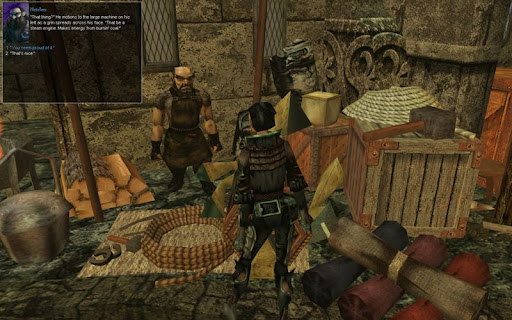
I've also begun adding more NPCs. Some of these fellows will be sitting down or walking around once my ambient system is working (yep, yet another system I'm doing from scratch; *sigh*). In this shot, there's a Federal agent wielding a government issue sidearm, a typical Midport guard, and an Automat. Automats are a recent invention in the world of Shadows & Silver; they're similar to golems, but based on science rather than magic. You'll see lots of them around the world and (if I get time to write the scripts) even be able to make or purchase one of your own.


You can see I'm adding plenty of placeables, but not every shop needs tons of wares around it. Here's a simple one that was quite fun to make.


Hope you enjoyed the shots. Here's a few more just for kicks.


Friday, July 11, 2008

Some progress

My computer's fixed now, so I'm getting back in the swing of things. It's coming rather slowly since I keep letting the basics of scripting trip me up, but I'm getting a decent spawn system worked out. I got things to spawn OnAreaEnter, but I still haven't begun work on trigger spawns yet. Still, I've got enough that won't need to be changed that I can begin working it into my building. One of my goals has been to have my NPCs spawn in and remain only when there are PCs in the area, which will keep them from using up cycles unnecessarily. I wanted to get that taken care of before I got too many NPCs for me to go back and change each one individually.

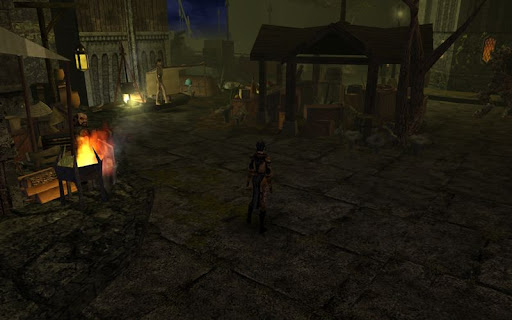
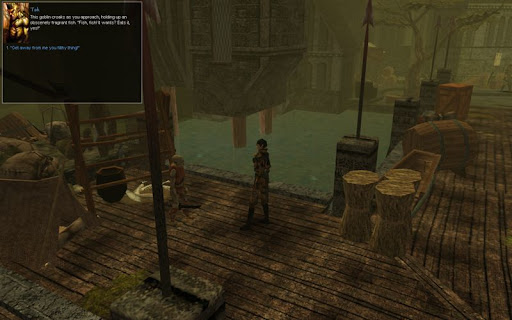
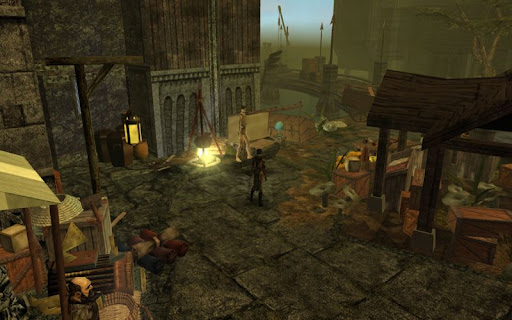
In other news, I've picked my building back up. I've connected two area to Manheim Court, but they don't have anything in them worth showing yet. Here's some screenshots, though, that show how my first area is beginning to fill out:


Tuesday, July 1, 2008

Again?

I've become convinced I am cursed with a demon computer. My CD drive, which I just had fixed, has decided to break and refuse to close. So now I get to send my laptop off again to be fixed. Joy.

On the other hand, I got to talk with Fester Pot, creator of the Almraiven module. If you haven't played this module, I highly recommend it. It's a city adventure that's heavy on the role-play. The most amazing thing about it is the incredibly believeable city. FP makes Almraiven come alive with excellent use of sound, placeables, and tight streets. This module has become my favorite and a great inspiration. Of course, you have to make some changes to form it into a PW, and building something this intricate is much more time consuming than designing a bunch of sparsely populated areas, which is what I've seen on many PWs. The payoff, I think, will be worth it.

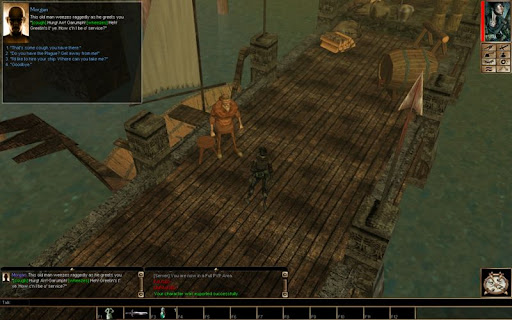
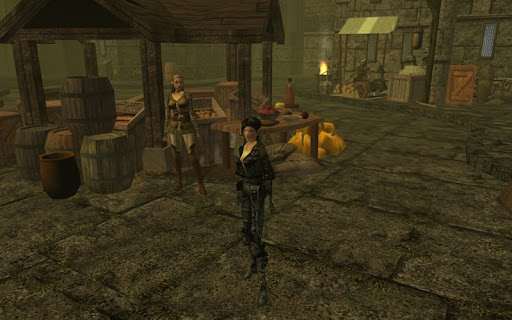
There's three key components FP mentioned that I'm trying to keep in mind: small areas with lots of alleys and tight construction, liberal use of placeables to give that lived-in feel, and heavy use of placed sound. Here's a couple of screenshots of the first area I've designed using FP's advice. As you can see, I'm only just starting, and there's lots of odd, empty spaces, even in this 5x5 area. Getting a variety of placeables that still seem to flow together is difficult, and I've never been much good with building anyway. Still, it's a start.

Morgan, one of the first NPCs players will meet.


Manheim Court, with two shops so far...


My favorite screenshot. Heiden, inventor-turned-junk-seller.


Cheers!

Wednesday, May 7, 2008

The Base, Part 4

In designing the starting city for the players, I need to settle on a few things to flesh it out. So far we've got a city that was near a battleground that has ruined the land, where food is difficult to grow, and where the poor are heavily oppressed and starved by the elite. It's good stylistic information, and you need to have a solid sense of flavor if you want your locations to stand out. But you also need some concrete details, so this time we'll work on that. Ray Winninger suggests several areas to start with:

A local authority:
Any home base needs to be at least somewhat stable. You don't want it being invaded by monsters or constantly having revolutions or wars. at least, not until your player base is sufficiently entrenched in the world to do something about it. Someone needs to keep control. In the case of our home base, we've already decided that whoever runs the place ultimately bows to the Church, so it could be run by the clergy. However, we also know that the local nobles manage to keep food locked away from the masses. Nobility suggests a monarchy. Now, while there is a historical precedent for clergy and monarchy vying for power, that smacks of the Middle Ages, and I want something more modern. Imperialism is closer to the attitudes I imagine people in this world having, so let's use that.

Our city was once part of a large mannish empire that spanned much of the known land. It had spread by conquering feudal territories, and those rules that surrendered peacefully were promoted to high-ranking government offices. Often, this meant oversight of local industry, which was controlled by the state. After the fall of the empire (due to plague and the recent war), many nobles fragmented their lands with war as they tried to carve their own feudal kingdoms from the carcass of the empire. As one of the core provinces, our city was particularly favored by the imperial Church, which worked hard to maintain order. As a result, most of the original government still stands, though lack of oversight by an emperor has allowed the officials to seek their own interests, rather than the good of the state. The government, then, is a small republic which represents the upper class: former imperial officials, wealthy families, and businessmen. Wealth gets you a place in politics, and the purpose of the political system is to maintain the privilege of the elite. The fact that the city is one of the primary trading ports in the old imperial lands means that they make quite a killing.

Who, though, is in charge? I'll settle on a fellow named Albus Engelhardt. Though he comes from a long line of nobles, he's chosen to ally himself with the imperial remnant, preferring his title of Governor to any conferring royalty. My inspiration for him comes from Havelock Vetinari of the Discworld novels. He's ruthless, but smart enough to realize he can't be brutal. As such, he courts the Church, and their charity work helps to pacify the populace. He also maintains efficient control over the republic, guiding policies so that the only entrench him more into power. Also of note in the city are the Harbormaster (who controls the docks and, thus, trade), the Marshal (who commands the city guard), and the Pontifex (the local head of the imperial Church).

That's a major piece of the puzzle, which means we need a secret about the rulers. I'm settling on the fact that Engelhardt has orcish blood in his veins, a fact he keeps quite hidden.

Townsfolk:
A city isn't just composed of rulers. They have to have someone to rule, and these are the people who the players will encounter most often. Where do they live and what do they do? What lifestyle do they have? How many are there?

I already know that the poor are starving wretches. But my more modern civilization suggests there is a rising middle class. I'm going to divide my townsfolk into three groups, then: the upper class (the aforementioned nobles, but also business owners), the middle class (merchants and shopkeepers), and the lower class (factory workers, farmers, and laborers). I know I want my city straddling a river, and this provides the perfect opportunity to split them up. The southern side of the river will be called the Southside, and is largely slums where the poor live. The Upper Side (side the Northside just doesn't sound as neat as Southside) is where the upper and middle class live, though the upper class citizens live in walled communities. The centers of business are located near the docks, so the wealthy either conduct business there or works from their homes through aides. I think my middle class's shops should be located in high-traffic areas such as the major roads and the docks, though there will be a few mingled with the general housing. The slums have plenty of little gardens and street merchants, but most of their work is done in the large factories the slums are centered around. The desperate and criminals slave away at the water treatment plant upriver. All in all, I'd say there's around 70,000 people in this city. There were far more, but many have fled or died because of famine and plague.

What's a secret for this? Those plant workers? Their bodies and minds are often horribly twisted from constant exposure to the toxins in the water, and there are a few communities of crazies scattered throughout the slums.

Shops:
Players need to buy things, and NPCs need to make money to survive. The lower class is likely to be more self-sufficient than the upper and middle class, since these two groups often specialize in their labor types. This means you'll generally find more shops in the richer quarters, and the shops will be more specialized the more wealthy those living in the location are. what types of things are for sale? What is the place known for? What is rare and in high demand? What is worthless?

Since factories are common in this city, we'll say there's plenty of manufactured goods. Metal implements are likely sold by large businesses, and they'll likely be cheaper than hand-made ones. Still, in a city like ours, crime is probably high, so basic weapons are likely to be easily obtainable. You'll be hard-pressed to find heavy armor or martial weapons here, though; those are banned by the government unless you have a licence. Wooden or cloth items are likely to be made by the general populace, though. I'm going to imagine that fine clothing, food, and books and other intellectual pursuits will be marks of wealth in this city. Local food is probably limited to bread, fish, and bland vegetables, so meat, spices, and fruit are likely to be hot commodities. I'm going to have some fun here and take a page from Firefly: some manufacturing companies have managed to synthesize proteins and combine them with high-density carbohydrates and other nutrients into bland but relatively nutritious food, sort of like protein bars. Everyone hates it, but it's cheap.

As for a secret here, I'm deciding that there's a thriving black market located in the sewers and slums. If you have the money, you can get some exquisite goods; but these are often stolen from nobles or the Church.

Temples:
Religion needs a place in most towns. Especially when people are as bad off as they are in Shadows & Silver, people need an opiate. Here, the Church fills this need. As the only sanctioned religion, it has small chapels and shrines scattered throughout the city. In the poor quarters, the chapels often are centers of charitable work, and soup kitchens are common. In the richer areas, they serve mostly to receive donations and prey on the rich's guilt over their oppression of the poor. The local pontifex makes his abode at a grand cathedral on an island in the middle of the river (which is where I'm also putting the seat of government).

Other religions are not as common as the Church of the Archons, but their cults do exist. Clergy of the Elemental Tides and the Fae Courts find their greatest supporters among the poor, who seek a change in the status quo. While the Church does not actively oppose these religions, their followers are often seen as troublemakers and are rarely trusted. Here's a secret: demon- and devil-worshippers are found most often in the wealthy sectors, where it has become vogue to dabble in black arts forbidden by the Church.

A fantastic element:
This is a fantasy, so we need something fantastic to distinguish the place and make it stand out in the minds of the players. I'm going to make this a secret about the city: some of the populace in the poorer quarters are afflicted with lycanthropy. On nights of the full moon, they roam the shadowy alleys. Their existence has never been proven, since the Church works behind the scenes to exterminate them. Gruesome killings are reported fairly often, though these are usually attributed to local gangs.

Alright, that's a lot of good stuff. But one thing is still bothering me: I don't have a name for my city. I've thought for a long time and think I've finally settled on one: Midport. I'm thinking it'll have been named for the island port in the middle of the river, which is now called Midport Proper. Sounds good!

So now I've got plenty of good solid details about Midport. How about some screenshots? The following pictures are made using the Gothic City and CC City Exterior tilesets, available on the NWVault. I think I like the Gothic City look better, since it's darker. It also feels more modern than the medieval-esque CC City Exterior shots. All of them are devoid of placeables and NPCs, though I went ahead and put some doors in so they didn't look too odd. Look at 'em and tell me what you think. First the Gothic City...


And now the CC City Exterior...


Next time we'll work some on the world at the national level. Until then, enjoy the screenshots!

Friday, May 2, 2008

The Base, Part 3

One of the keys to designing a world is to never force yourself to design more than is necessary. This, according to Dungeon Magazine's Ray Winninger, is the first rule of Dungeoncraft. Enthusiastic world builders often get bogged down in unnecessary details, such as weather patterns, monetary exchange rates, and the correct orcish insult to use when addressing your mother-in-law. Just as often, we design massive civilizations with hundreds of cities, each of which we try to map down to the last bakery, or try to generate a fifty-god pantheon. Players really don't care about your lovingly crafted world nearly as much as you do, and if your force all these details on them, they're going to be bored. Granted, players want to see that you've put time and effort into your world, and enthusiastic role-players may look for as many juicy bits of lore as they can. But the majority of your players want to go have fun adventures in your world. Your job as a world builder, then, is to give them the opportunity to do this.

At minimum, a game world should contain two things: an adventure site and a place where players can rest, sell loot, and buy equipment. Usually, the place where they rest is where they will start in the game. It makes the most sense, really, as it gives the players a chance to stock up on equipment so they don't get slaughtered in their first adventure. The ideal location for a home base like this is a city where all the PCs needs are met... if they have enough money. A home base also needs to have adventure hooks so players have a reason to go out and kill things and take their stuff (something that's all too lacking in many of the modules I've played).

But even going around killing things and taking their stuff gets old after a while. You'll want to keep plenty of things around for the players to do. This means having plenty of quests, new things to discover and, of course, more things to kill. You don't want to design all these new things up front, though. Remember the first rule of Dungeoncraft: never force yourself to design more than you need. What you do design, though, should have lots of hook-ins for you to later expand your world. Mr. Winninger thus states the second rule of Dungeoncraft: Whenever you design a major piece of your world, make some secret to go along with it. That can be just a bit of lore that changes how people would see your world (or, at least, that aspect of it) if they knew it.

You don't want everything to be a big, jumbled mess, though. Everything should flow together logically. Your players may not have all the details as to why things are the way they are, but you should, and everything should make sense from your omniscient viewpoint. I'm going to create a third rule of Dungeoncraft, then: everything you design should make sense in the context of the whole world.

Let's start building my world, then, by thinking up a home base. In accordance with Rule 3, I want a place that embodies many of the themes of the world. This will help the players to understand right away what kind of world Shadows & Silver is. My first inclination, then, is to make it a city, one that reeks of the problems of modernization. I've already talked about wanting to have natural disaster and famine play a part in the daily struggle for survival that so many face, so we'll start by supposing this city was one of many battle grounds for a fairly recent war that destroyed much of the terrain. The ground no longer supports hardy crops, and the water has become poisonous. That's some war! Well, in accordance with Rule 3, we've got to make it make sense. Why do people still live here if it's so bad? The obvious answer would be that the rest of the known world has gotten so bad that this is simply one of the best places to be. But how do they get their sustenance? I've long imagined that the city straddles a river at the mouth of an ocean, and a ways upstream they've built a large facility that purifies the water. It does this, of course, at a cost of high air pollution. But it's more important to have drinkable water than clean air, right? This is a great example of people turning to technology to answer problems technology caused, all the while making things worse. I'll also suppose that the city itself wasn't the site of the battle. No, that was further upriver, and all the fallout washes downstream. It's soured the soil, but the treatment plant is slowly allowing things to return to normal... except its air pollution makes crops suffer, so there's a limit to how well crops grow.

So what I have here is a sort of environmental hook. Our city is a place where people find it very difficult to get anything to eat. Because of where it's situated, it's probably a trading hub, since it can send ships up and down the coast as well as up and down the river. This means it can also likely get food by trade, but that food is bound to be expensive, especially if other lands are having similar troubles. What does that imply about the nature of the city? Well, it gives me an opportunity for a classic rich vs. poor conflict. The rich hoard all the food while the poor starve.

Okay, Rule 2 demands we make some secrets to go with the major pieces we've put together. Now, I don't want to make anything too spoiler-ish here, in case future players of my module are reading this, but I suppose it's necessary if I want to show the build process in action. I expect that no future players will use this information to metagame.

There's three major pieces I've shown so far: a major war that devastated the countryside, a water treatment facility, and rich people hogging all the food. The first one, I think, is that this huge war was instigated by industrial corporations hoping to profit from selling war machines to the government. That may not be much of a secret. I imagine that, while plenty of people have a patriotic streak and think that their country was justified in whatever war it entered, many are cynical and see no gain from the war. Oh, and we'll also say they lost (as may be guessed from the devastation caused to the countryside). The second one is fun, too. The corporation that owns the treatment facility is one of those that instigated the war. All lands watered by this river now have to pay them as much as they want unless they want their people to be horribly poisoned from the fallout. The one about the poor people starving: no matter how little food they receive, they still manage to catch enough fish to survive. How they can catch anything reasonable in the still somewhat poisoned water, though... well, I'll hang onto that one. I've got a wicked idea that will probably become one of my adventures on down the line.

So now I've got a great start for my home city, some neat hooks to tie future plot lines into, and some basic conflicts. We need an adventure hook, though. How's this: the other party in the big war was an alliance of orc tribes, which took up residence in the spoiled parts of the land. They're hardy enough to survive in those places, but they're spreading. The local authority wants them pushed back. This suggest an adventure area where you get to fight orcs. It's not because the orcs are evil that the authority wants them driven out; it's because they have something he wants.

Which leads me to a secret: the spoiled land isn't worth much in its present condition, so the argument that the land only wants its territory back is a weak one. I decide that there's something of incredible value in that territory that civilized leaders want badly enough to risk war to get. I don't know what it is yet, but that's okay. If they told anyone, there would be a risk that the orcs would find out and they'd start looking for it. No, instead, they just pay top dollar for any magic items brought back, regardless of what they are. I'll further suppose that it's not the ruler of this city but the head of the Church that wants them, and he's only told the local nobles that he wants any magic items that are found. Oh, and magic items have been declared contraband by the Church anyway, so anyone caught using them is committing a crime. Turning them over to the Church and getting paid is better than rotting in a jail cell any day.

Great start! Next time we'll tackle some more of the specifics of the world like government. In the meantime, I'll keep working on building so I've got some more good screenies of home base.

Tuesday, April 29, 2008

The Base, Part 2(ish)

I'm currently beating my head up against a wall. After spending days working on my XP system and Reputation system (and, by the way, getting only about three hours of sleep a night), I have about 4000 lines of code, none of which work the way I want. I can't nail down what the systems are even doing, much less where they are messing up. I'm tired of looking at code, but I don't want to get up until I fix the damn thing. I suppose I'll go pour myself a stiff drink and try to cool off.

As important as scripting is, that's not all there is to building a persistent world. You've also got to have areas, and building areas is Casa's strong point, not mine. Nevertheless, I thought I'd show a couple of scribbles of my own to show the direction I'm planning on taking my world. Shown are a couple of the intro areas: the jail cell the PC wakes up in, and a shot of home base.

It's not much, and it's practically devoid of placeables right now. But it does give a general idea of how the world will look. Dark, gritty, and ominous. I think proper lighting will play a large part in the design, as will strategic use of placeables to make everything look dirty and cluttered. This gets my creative juices flowing. I'm not great at building beautiful areas, but I can definitely think up how things should look based on an artistic style.

Next time I'll start outlining the layout of the land, especially home base, the city where the PCs will likely spend most of their time.