
Tuesday, August 21, 2012
New digs!
For those who didn't know, this blog has a new home at www.shadowsandsilver.com. Update your RSS links! All the content has been moved and integrated with the forums. If you have a forum account, you can use that to comment.

Friday, July 9, 2010
Ruleset, part 1
Hi all, Sherincall here..
Seeing as we haven't been around for a while, it is only fair that we show something good when we come back. That something is our new ruleset. Unfortunately, it is not finished, so we can let you play with it just yet. Until such a time comes (soon!), I'll just give you a quick overview of it.
There are no classes in the Shadows and Silver ruleset: everyone plays as a generic PC class. Sounds dull? Not really. Rather than limiting a character to three strict classes, we allow seamless customization for all character types. If you want to play a sword master who is interested in the arcane, and also obsessed with locks, you needn't be a fighter/wizard/rogue. You will simply increase the skills you want. In order to achieve this, we had to modify most of the skills, and add many new ones. Here are the skills present in the S&S ruleset at the moment:

There will be a detailed explanation for all of the skilled listed above, but for now let's just say that the Arcana skills will be used to perform actions similar to spellcasting in NWN, combat skills will increase your battle prowess, such as attack bonus, armor class, damage and even attacks per round. Most other skills are self-explanatory.
Another novelty to the NWN skill system is that skills can now be progressed without gaining a level. So, if you want to train your marksmanship skill, you can either gather experience and put a point in the skill at level up, or you can pick up a bow and practice. This goes for every skill, and those cross class skills can only be perfected this way.
That's it for now. Next time I will explain how feats work in the new ruleset. After that, you will get a chance to try it for yourselves.. I'm eager to get some feedback.
Seeing as we haven't been around for a while, it is only fair that we show something good when we come back. That something is our new ruleset. Unfortunately, it is not finished, so we can let you play with it just yet. Until such a time comes (soon!), I'll just give you a quick overview of it.
There are no classes in the Shadows and Silver ruleset: everyone plays as a generic PC class. Sounds dull? Not really. Rather than limiting a character to three strict classes, we allow seamless customization for all character types. If you want to play a sword master who is interested in the arcane, and also obsessed with locks, you needn't be a fighter/wizard/rogue. You will simply increase the skills you want. In order to achieve this, we had to modify most of the skills, and add many new ones. Here are the skills present in the S&S ruleset at the moment:

There will be a detailed explanation for all of the skilled listed above, but for now let's just say that the Arcana skills will be used to perform actions similar to spellcasting in NWN, combat skills will increase your battle prowess, such as attack bonus, armor class, damage and even attacks per round. Most other skills are self-explanatory.
Another novelty to the NWN skill system is that skills can now be progressed without gaining a level. So, if you want to train your marksmanship skill, you can either gather experience and put a point in the skill at level up, or you can pick up a bow and practice. This goes for every skill, and those cross class skills can only be perfected this way.
That's it for now. Next time I will explain how feats work in the new ruleset. After that, you will get a chance to try it for yourselves.. I'm eager to get some feedback.
Tuesday, July 6, 2010
The Role of Fantasy in Fantasy
While reading this post over at the Borders Sci-fi blog, I was reminded of the role of fantasy in fantasy. It is not, as Mark reminds us, simply escapism. It's a mirror that we hold up to reality. Living behind our eyes as we do, we need to see our selves from outside our bodies in order to truly know what we look like, and the same is true of reality. The difficulty is that, to cope and survive in a world of daily horrors, we become desensitized to reality. Thus, the beauty of fantasy is that it skews reality in such a way that it can be seen even while we wear our blinders, and that it shows us reality better than we could have hoped to see it on our own.
The work of the author (or DM), then, is to show the reader (or player) that the fantasy is, in fact, not fantasy at all, but a symbolic representation of reality. Now, that doesn't mean we need to beat folks over the head with heavy-handed moral lessons. Rather, the object is to stimulate the mind through the power of abstraction and imagination.
Consider the world of Richard Mitchell in his book The Gift of Fire:
As I look back on the world that I have been constructing, I sense that I have not done my poetic duty, casting light on the universal by example of the particular. My dealing with sexism or racism is an attempt to illustrate how the universal principle in our world applies in my world of fantasy. But the thing that should be happening is the freeing of the mind to wander, and to wonder:
What does the fantastical in this world symbolize? What does it say about the world? What does it say about me? And how can I better understand how it is with us humans by examining the implications of the symbolism?
The work of the author (or DM), then, is to show the reader (or player) that the fantasy is, in fact, not fantasy at all, but a symbolic representation of reality. Now, that doesn't mean we need to beat folks over the head with heavy-handed moral lessons. Rather, the object is to stimulate the mind through the power of abstraction and imagination.
Consider the world of Richard Mitchell in his book The Gift of Fire:
The strange power that we call imagination is at once a form of thinking and a useful aid to more thinking. Imagination can be understood as at once a kind of intelligence and a kind of poetry, which we ordinarily think of as something not at all intellectual but "creative." A bad mistake. Poetry and intelligence have one tremendous power in common. Each is a way of discovering, and of revealing, that things very different from each other are also like each other, and that similar things are very different from each other. Metaphor is in the heart of each, some way of language that can treat a city seen at dawn in the distance as though it were a sleeping creature and a girl as though she were a rose.
It is mind that does such things, of course, and if that way of understanding is to be called creative, then we might better understand human "creativity" not as some unaccountable and maybe emotional urge within, but as thinking. As such, it is remarkably useful in the mind's work of knowing itself.
My mind to me, a kingdom is, says the poet. Well, that's nice. It is hardly one of the great, sonorous lines of mighty verse, but it does stay in the mind. And we can think about it, which might be better than "appreciating" it, whatever that might mean. It would be fun to have the poet here, to ask him some questions about his curious assertion, and even to consider whether or not he has gone a bit too far. Can it be that what he says is simply a truthful description of some might and majesty, or is he perhaps boasting a little about his independent, sensitive, poetic mind? And, an even more important question: Is he doing his proper duty as a poet, and casting light on some universal by example of the particular, or is he just "expressing himself"?
So, your mind is a kingdom, eh? What sort of a kingdom is it? Are the borders open or jealously guarded? Do the citizens rejoice in their king, his just laws, and his kind governance, or do they have to console themselves with the thought that someday they will get to die and escape all this? Are the king's officers arrogant or cordial in the execution of their duties? Do they take bribes?
And how about the politics of your little kingdom? Is there a perpetual feud going on between the conservatives and the liberals? Is the king himself the king of all, or is he the leader of one of the factions? Is he in secure possession of his throne, or is he beset by pretenders? Is there any danger of revolution? Which side would you be on?
As I look back on the world that I have been constructing, I sense that I have not done my poetic duty, casting light on the universal by example of the particular. My dealing with sexism or racism is an attempt to illustrate how the universal principle in our world applies in my world of fantasy. But the thing that should be happening is the freeing of the mind to wander, and to wonder:
What does the fantastical in this world symbolize? What does it say about the world? What does it say about me? And how can I better understand how it is with us humans by examining the implications of the symbolism?
Saturday, January 23, 2010
Custom Content Spotlight: NWNCQ
If you've been living under a rock, you may have missed the latest awesome custom content. Well, I say latest, but it's been around for a while, steadily picking up steam. It's called NWNCQ, and it's an overhaul of stock BioWare tilesets. There's some other goodies like reskinned placeables, but most of the fun comes from seeing old gross areas that looked dated even in 2002 suddenly looking new and wondrous again. I decided to test it out on my all-time favorite server, Nexus: the City Between Worlds.

The screenshot above was taken in an area designed with using the standard Rural tileset. Oh, and you're only seeing two or three placeables (the campfire and the mushrooms) in all of that. While you pick your jaw up off the floor, lemme say this is because the idea of NWNCQ is to create environments that look incredibly detailed without the builder having to crowd it with placeables. You can get a thick, tangled forest using only the features included in the stock tileset. Additionally, since the detail is confined to the tileset, you don't have to worry nearly as much about pathfinding lag as you would have with a horde of placeables.

Probably the greatest thing about NWNCQ is that it's available in both hak and override form. This means you can incorporate it into your module, or have it incorporated into any module you play. Hence why I can hop onto a running server and see the beautiful content without having to get the admins to install it.
chico400, creator of NWNCQ, has incorporated some good design into the project to make it painless to use. First, override versions of the tilesets make it possible to walk through trees, rocks, and other added details, so you don't have to worry about places formerly accessible now being unreachable. The hak version doesn't do this, since you're planning on building with it and can work within its constraints.
Second, he includes a batch utility to selectively activate or deactivate overrides. While you could just delete the files of a particular tileset that you don't like, chico's utility puts it aside in a special folder. This is particularly good if, say, you want the updated look for one module but not another. Activate it before you play the first module, then deactivate it when you want to play the second.
Performance is very smooth, even with shadows and anti-aliasing, and chico has tried very hard to ensure that fading geometry works well. The end effect is that you have very organic areas that still run well and are a pleasure to play in.
Other features of the package include pseudo-bloom...

...pseudo-bumpmapping...

...animated lens flares...

... and nicer textures.


In short, it's easy, it's painless, and it brings old yucky areas back to life... whatever module you play on. Try it out!
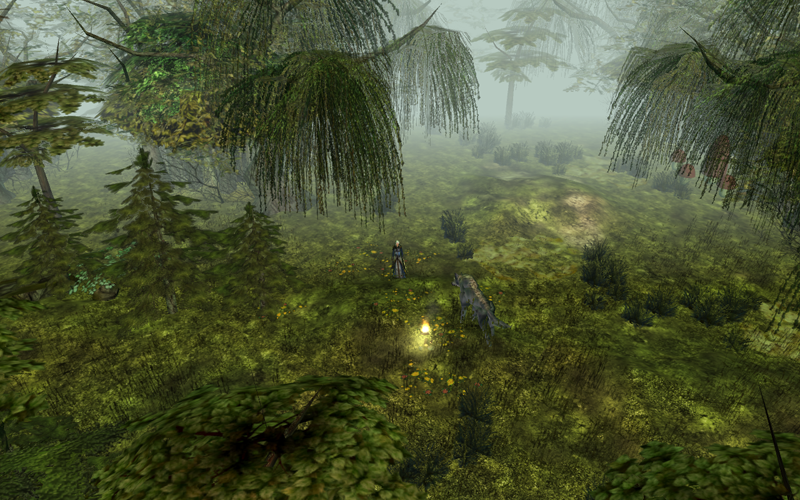
The screenshot above was taken in an area designed with using the standard Rural tileset. Oh, and you're only seeing two or three placeables (the campfire and the mushrooms) in all of that. While you pick your jaw up off the floor, lemme say this is because the idea of NWNCQ is to create environments that look incredibly detailed without the builder having to crowd it with placeables. You can get a thick, tangled forest using only the features included in the stock tileset. Additionally, since the detail is confined to the tileset, you don't have to worry nearly as much about pathfinding lag as you would have with a horde of placeables.
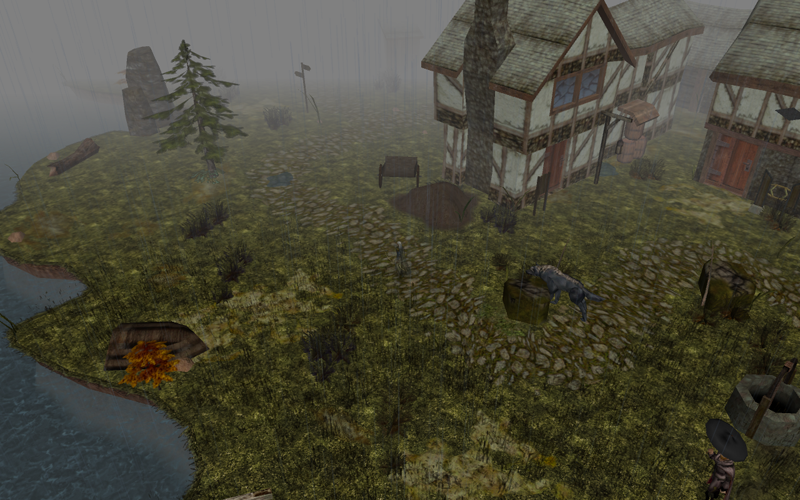
Probably the greatest thing about NWNCQ is that it's available in both hak and override form. This means you can incorporate it into your module, or have it incorporated into any module you play. Hence why I can hop onto a running server and see the beautiful content without having to get the admins to install it.
chico400, creator of NWNCQ, has incorporated some good design into the project to make it painless to use. First, override versions of the tilesets make it possible to walk through trees, rocks, and other added details, so you don't have to worry about places formerly accessible now being unreachable. The hak version doesn't do this, since you're planning on building with it and can work within its constraints.
Second, he includes a batch utility to selectively activate or deactivate overrides. While you could just delete the files of a particular tileset that you don't like, chico's utility puts it aside in a special folder. This is particularly good if, say, you want the updated look for one module but not another. Activate it before you play the first module, then deactivate it when you want to play the second.
Performance is very smooth, even with shadows and anti-aliasing, and chico has tried very hard to ensure that fading geometry works well. The end effect is that you have very organic areas that still run well and are a pleasure to play in.
Other features of the package include pseudo-bloom...
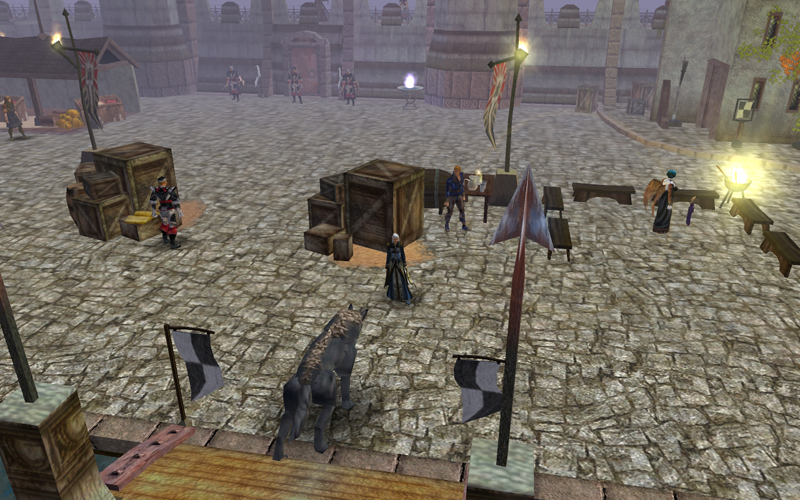
...pseudo-bumpmapping...
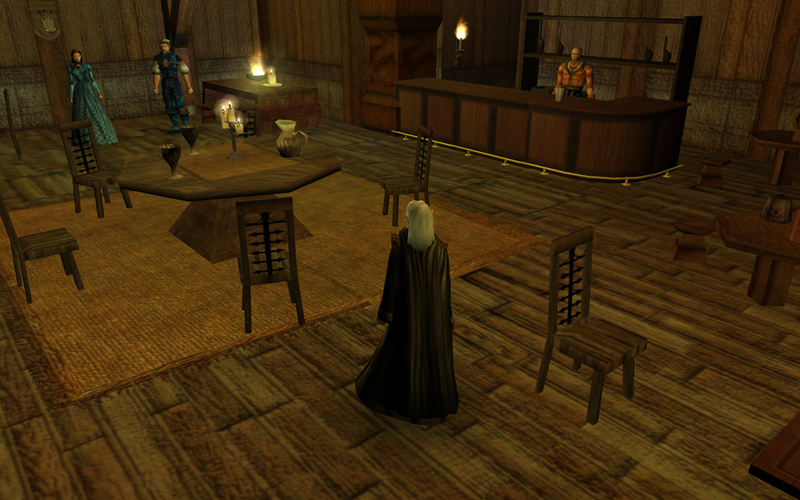
...animated lens flares...
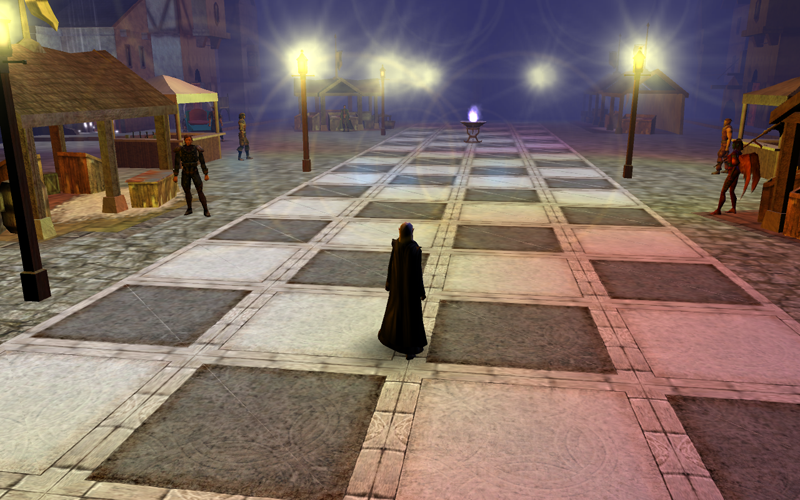
... and nicer textures.
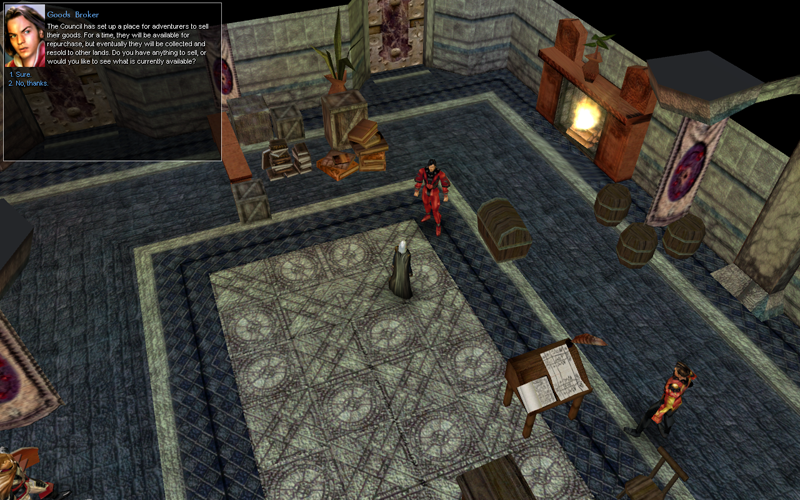
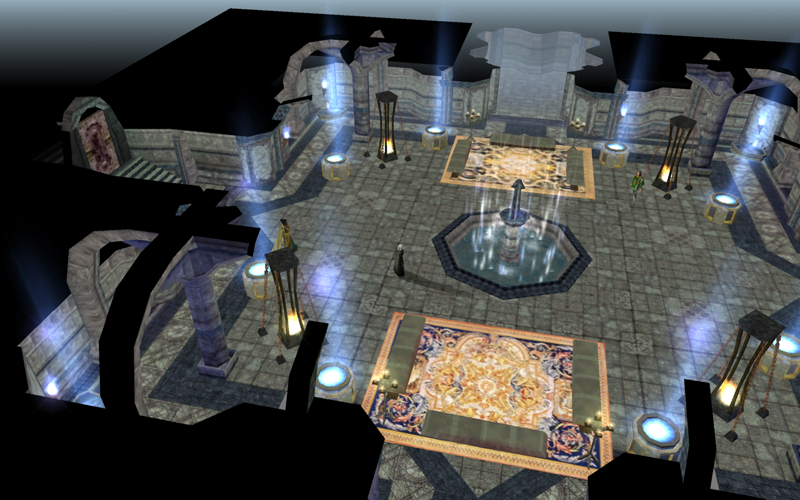
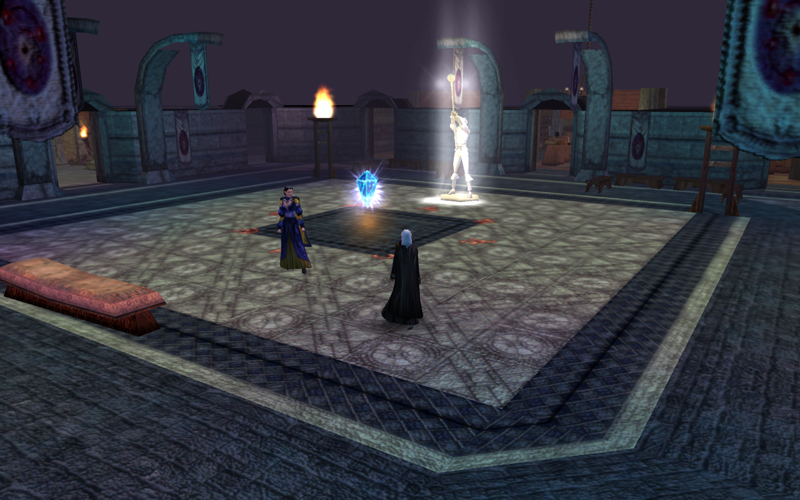
In short, it's easy, it's painless, and it brings old yucky areas back to life... whatever module you play on. Try it out!
Friday, January 22, 2010
Which sucks more?
NWN2 or HP computers?
I got to test run Casa's Middleforest module and it's coming along nicely. The lighting is beautiful, and the city has a nice variety of pretty and grungy. I can enjoy it more now that I'm getting a little more used to getting the camera to do what I want, and I was actually able to get around Rungholdt without getting stuck this time. However, I did get a pretty bad problem after playing for a while.
My wireless card got uninstalled!
What? Well, it turns out the system board got so overheated playing the game that the soldering holding the wireless card onto it melted, and it detached from the board. Wow! So is that NWN2's fault for having obscenely poor performance on minimum settings? Or is it HP's fault for making their computers out of stuff flimsier than cardboard? This is the second time this has happened to me, but now the extended warranty I bought has lapsed and I can't send it in to be repaired.
The real kicker: I managed to fix the issue by playing NWN2 some more. It melted the solder back and so now I am using a wireless-capable computer once again.
Monday, January 18, 2010
Control! You must learn control! - Social Insanity, Part 3
This is the third post in a series that will look at different components of the amorphous blob called society and how they're relative to Shadows & Silver and to realistic game worlds in general. Last time we discussed gender stratification. Today's topic: Social Control.
Social control is the mechanism society uses to maintain the order necessary for its continuation. Society doesn't like to change; it formed the way it did for a reason, and it has evolved means with which to ensure its continued existence.
Social control is the mechanism society uses to maintain the order necessary for its continuation. Society doesn't like to change; it formed the way it did for a reason, and it has evolved means with which to ensure its continued existence.
There are two basic types of social control. The first is internal control, in which a person is indoctrinated in the values of his society and left to control himself. The second is external control, in which an outside entity (usually an authority figure) provides incentives or deterrents to bring about the desired behaviors in a person.
Internal control is the first defense of society, and often the most effective. Consider, for example, two men who have a grievous disagreement. Will they resort to murder to win their argument? It's unlikely, as evidenced by the fact that many people have such disagreements while few people are murderers. But might we say that this is because of the penalty for murder imposed by the government? To consider this, let us suppose that the two men are spirited away to a far off land, devoid of other people, of law, and of punishment. What will become of them? Will one choose to take the life of the other, will they find a way to settle their dispute, or will they go their separate ways?
Of course, we cannot know the answer for any given man; I can, though, find the answer if I am one of the men in question. If it were me in that far-off land, how would I conduct myself? Would I bow to a law within in the lack of a law without? I would indeed. And since I am, I suppose, an average member of this thing called society, I may then suppose that the average man would do likewise. And so I may conclude that the law that controls the average man from within is more powerful than that which controls him from without.
I have been taught, as have others, to conduct myself in an orderly manner and to treat my fellows as I would wish to be treated. While, in my case and in that of many others, that conviction is of a religious sort, this is not the case with everyone. The urge to control ourselves is as much a practical urge as it is a religious one. We have found that, by co-existing peacefully, we lead better lives than if we did not. Furthermore, we may conduct our affairs without constantly guarding against the malice of others because we may assume that others abide by the same rules that we do.
The manifestations of internal control are two-fold. First, it appears as the action of a conscience, that part of our mind which tells us what we do not wish to hear. When I go to act as I wish, my conscience steps in and reminds me to act as I ought. Second, it appears as the fear of rejection from society. I also act as I ought for fear that I may displease others and so forsake the social bonds I have formed with them if I act as I wish. These two things allow me to control myself unconsciously.
But if internal social control is so effective, why do we need to resort to external control? We often speak of deviants, or criminals, who forsake the values of society to the detriment of others. External control can be both the punishment of the anti-social and the reward of the social. A parent who spanks his child for wrong-doing exhibits external social control, as does one who gives him a cookie for doing what is right. From an early age, this sort of control instills in us a sense that doing what we ought will lead us to pleasure and that doing as we wish will lead us to pain. External control thus results in our ability to control ourselves.
But the very existence of government tells us that the external control of our parents does not always result in people who can govern their own actions. Perhaps it is the result of improper parenting. Perhaps it is the result of a particularly willful or unsociable mind. Whatever the case, some people do not internalize the control exhibited by their parents and become social outcasts. Those who do so in a way not physically harmful to others are considered simply deviant, while those others are considered criminal. At times the lines are blurred depending on how the society views harm. In any case, society then takes it upon itself to correct the slight through sanctions whether physical or social. Perhaps it is incarceration or a fine. Perhaps it is the refusal of others to socialize with the outcast. Whatever the case, society ensures that it will not tolerate the behavior of the outcast until he internalizes the external control that society provides.
So what are we to make of all of this, and how are we to apply it to the game? There are many applications of the concept which we will begin discussing in later posts. For now, however, let's consider social control in the case of gender roles.
Gender roles persist because society has instituted social controls to enforce the order that maintained its existence for so long. There are internal controls in the form of values (e.g., "a woman's place is in the home") and deterrents (e.g., "what will people think of me if I don't marry?"). There are also external controls in the form of societal pressures (e.g., women who buck the social order are looked down upon), incentives (e.g., praise for "the virtuous woman"), and laws (e.g., women are not allowed to vote, own property, etc.). Even if the laws were to be changed, the internal values get passed on for generations, meaning a society based on ensuring the safety and domestication of women will remain the same de facto if not de jure.
Lore snippet: Nerathul society developed in the wastes of the eastern Plain. The need for strong leaders resulted in a paternalistic society. The treatment of women varied across the vast lands of the Nerathim, but classical Nerathul society emphasizes respect for parents of both genders. In that societal model, motherhood and fatherhood are regarded with equal reverence. Thus, each woman is expected by society to strive to bear children. A woman who does bear children is accorded legal status and, unlike in Adunay, may own property. An unmarried woman or one with no children, however, is considered worthless and a shame to her husband. Of course, a woman who has children and abandons them to seek a career breaks the code of parenthood, so the opportunities for women in Nerath are still limited.
Conclusion
Social control, as the mechanism by which society maintains itself, should have a prominent role in any realistic gameworld. Consider what sorts of internal and external control are present in your world, both for NPCs and for PCs, in order to make the society function. Doing this will go a long way towards helping you understand the psychology of your society.
Saturday, January 2, 2010
My Fair Lady - Social Insanity, Part 2
This is the second post in a series that will look at different components of the amorphous blob called society and how they're relative to Shadows & Silver and to realistic game worlds in general. Last time we discussed racism. Today's topic: Gender Roles.
I remember when one of my college history courses covered the American feminist movement. At one point the professor asked for all the girls in the class that were feminists to raise their hands. Out of the 70 or so girls in the class, only two did.
"Do you mean to tell me," the professor asked, "that only two of you are in favor of a woman's right to vote or to own property or have any legal status whatsoever?"
One student responded, "Well, everybody wants that. We just mean we're not bra-burning lesbians."
As society has rolled along, feminism has moved from the equal rights movements of the turn of the century to the militant feminism of the 60's and 70's to the emphasis on democratic reform we find so often today. Feminism today has different implications than it has in the past. But while the connotations and specifics have changed, the overall situation remains the same. After millennia of struggles, try as we might, there's still gender inequality, both de facto and de jure, both at home and abroad.
Curious, then, how we seem to conquer the issue so easily in fantasy worlds.
Perhaps it's the idealism that finds its way into fantasy, the same sort of worldview that results in black and white depictions of morality. Surely, if the land espouses all that is noble and just, it will support equal rights for women and everything will be wonderful, right? In fantasy we so often seek to fix the ills of society only to replace them with ham-fisted lessons about how good will triumph over evil. We force contemporary worldviews on a society apparently so backwards that it's managed to remain in a feudal state for thousands of years, then don't even stop to think about the implications. If your fantasy world doesn't assume gender stratification, you're missing a valuable opportunity for roleplay and powerful storytelling.
How did gender stratification begin? Sociologists usually assume it was a natural outgrowth of biological capabilities: men, being stronger took on the role of provider and protector, while women, as the bearers of children, took on the domestic roles that kept them close to home, protected as a valuable resource in the continuation of the species. Social evolution, in other words. Those societies that didn't develop in this way put women at risk, decreasing the chance that enough women would bear children for the society to survive.
This makes sense for a hunter-gatherer society, but why should gender stratification still exist after society transitioned to agriculture and the need for dangerous hunting was removed? And, even more vexing, why does it still exist in contemporary society where women are just as physically qualified as men for most jobs?
We can find one possible answer within Conflict Theory, a sociological discipline which was introduced by Karl Marx in Das Kapital. Marx focuses on the relationship between the bourgeoisie (business owner) and the proletariat (worker). The former controls all the wealth and power while the latter can only obtain wealth and power by serving his bourgeois master. The classes are therefore in conflict; the stronger exploits the weaker to increase his own wealth. We can extend the theory to gender roles: the man, supported by his physical power, exploits the woman. In a world dominated by men, women can only succeed where they bend to men's will, thus making the men even stronger.
Conflict theory is not the only answer we might turn to, however. Talcott Parsons expands on Emile Durkheim's theory of Functionalism, which states that society is the way it is because things serve a useful function. That stratification serves a useful function in the survival of hunter-gatherer humanity is not in dispute, so what function might the contemporary or agrarian society have fulfilled with gender stratification? We might suppose that, through evolution (whether social or biological) women were better suited to fulfilling a more passive role in society, having traits that made them better at their role. The theory goes that women are (whatever the bra-burning lesbians argue) more suited to the careful and nurturing role than are men.
People often bristle when they hear this statement. It's important to make the distinction, though, that we're talking about advantage, not about necessity. What do I mean? Simply that just because a woman's hormones and physical structure make her gentler doesn't mean that she should serve as a housewife, seamstress, or other passive role. It only means she is more capable of it than a man, whose biology and physiology makes him harder, less patient, and more aggressive.
But surely, nature is not all there is to the debate. There's nurture as well: how society has sculpted our personalities, our identities, and our view of gender roles. Girls like pink not because there is some biological imperative that says they must, but because society tells them they should like pink. The same goes for boys and blue. You're ostracized if you deviate from the norm. (The most formative socialization of this sort that occurs is in childhood interactions. As adults, we often decide we'll do what makes us happy, and to hell with the world if it doesn't like it. As children, though, we have a deep psychological need to feel included, part of a larger group. Hence why being popular is so important in high school and so un-important in later life.) Functionalism tells us, though, that society evolved its roles because they fit the biological and social needs of the time. So the perceived social role is only important to society in that it fulfills a need.
But wait! Do those old social roles still fulfill a need? Different cultures stem from different societies, so, surely, sometimes they do. In contemporary America, though, society has changed dramatically. The family structure is beginning to disintegrate. Our divorce rate is over 50%, and more than 25% of American children live in single-parent homes. In addition, the living standard of the average American family is dropping dramatically, requiring even married partners both to leave the home and work just to break even. More and more, the role of the woman as the caretaker of children is exchanged for the role of provider and, unfortunately, she still is not seen as capable of providing, though necessity dictates she must be.
I remember when one of my college history courses covered the American feminist movement. At one point the professor asked for all the girls in the class that were feminists to raise their hands. Out of the 70 or so girls in the class, only two did.
"Do you mean to tell me," the professor asked, "that only two of you are in favor of a woman's right to vote or to own property or have any legal status whatsoever?"
One student responded, "Well, everybody wants that. We just mean we're not bra-burning lesbians."
As society has rolled along, feminism has moved from the equal rights movements of the turn of the century to the militant feminism of the 60's and 70's to the emphasis on democratic reform we find so often today. Feminism today has different implications than it has in the past. But while the connotations and specifics have changed, the overall situation remains the same. After millennia of struggles, try as we might, there's still gender inequality, both de facto and de jure, both at home and abroad.
Curious, then, how we seem to conquer the issue so easily in fantasy worlds.
Perhaps it's the idealism that finds its way into fantasy, the same sort of worldview that results in black and white depictions of morality. Surely, if the land espouses all that is noble and just, it will support equal rights for women and everything will be wonderful, right? In fantasy we so often seek to fix the ills of society only to replace them with ham-fisted lessons about how good will triumph over evil. We force contemporary worldviews on a society apparently so backwards that it's managed to remain in a feudal state for thousands of years, then don't even stop to think about the implications. If your fantasy world doesn't assume gender stratification, you're missing a valuable opportunity for roleplay and powerful storytelling.
How did gender stratification begin? Sociologists usually assume it was a natural outgrowth of biological capabilities: men, being stronger took on the role of provider and protector, while women, as the bearers of children, took on the domestic roles that kept them close to home, protected as a valuable resource in the continuation of the species. Social evolution, in other words. Those societies that didn't develop in this way put women at risk, decreasing the chance that enough women would bear children for the society to survive.
This makes sense for a hunter-gatherer society, but why should gender stratification still exist after society transitioned to agriculture and the need for dangerous hunting was removed? And, even more vexing, why does it still exist in contemporary society where women are just as physically qualified as men for most jobs?
We can find one possible answer within Conflict Theory, a sociological discipline which was introduced by Karl Marx in Das Kapital. Marx focuses on the relationship between the bourgeoisie (business owner) and the proletariat (worker). The former controls all the wealth and power while the latter can only obtain wealth and power by serving his bourgeois master. The classes are therefore in conflict; the stronger exploits the weaker to increase his own wealth. We can extend the theory to gender roles: the man, supported by his physical power, exploits the woman. In a world dominated by men, women can only succeed where they bend to men's will, thus making the men even stronger.
Conflict theory is not the only answer we might turn to, however. Talcott Parsons expands on Emile Durkheim's theory of Functionalism, which states that society is the way it is because things serve a useful function. That stratification serves a useful function in the survival of hunter-gatherer humanity is not in dispute, so what function might the contemporary or agrarian society have fulfilled with gender stratification? We might suppose that, through evolution (whether social or biological) women were better suited to fulfilling a more passive role in society, having traits that made them better at their role. The theory goes that women are (whatever the bra-burning lesbians argue) more suited to the careful and nurturing role than are men.
People often bristle when they hear this statement. It's important to make the distinction, though, that we're talking about advantage, not about necessity. What do I mean? Simply that just because a woman's hormones and physical structure make her gentler doesn't mean that she should serve as a housewife, seamstress, or other passive role. It only means she is more capable of it than a man, whose biology and physiology makes him harder, less patient, and more aggressive.
But surely, nature is not all there is to the debate. There's nurture as well: how society has sculpted our personalities, our identities, and our view of gender roles. Girls like pink not because there is some biological imperative that says they must, but because society tells them they should like pink. The same goes for boys and blue. You're ostracized if you deviate from the norm. (The most formative socialization of this sort that occurs is in childhood interactions. As adults, we often decide we'll do what makes us happy, and to hell with the world if it doesn't like it. As children, though, we have a deep psychological need to feel included, part of a larger group. Hence why being popular is so important in high school and so un-important in later life.) Functionalism tells us, though, that society evolved its roles because they fit the biological and social needs of the time. So the perceived social role is only important to society in that it fulfills a need.
But wait! Do those old social roles still fulfill a need? Different cultures stem from different societies, so, surely, sometimes they do. In contemporary America, though, society has changed dramatically. The family structure is beginning to disintegrate. Our divorce rate is over 50%, and more than 25% of American children live in single-parent homes. In addition, the living standard of the average American family is dropping dramatically, requiring even married partners both to leave the home and work just to break even. More and more, the role of the woman as the caretaker of children is exchanged for the role of provider and, unfortunately, she still is not seen as capable of providing, though necessity dictates she must be.
We can't solve the ills of society in a little blog post. But, by extension, neither can we solve them in a game. And really, should we? If conflict is the center of storytelling, isn't the base conflict of woman versus the limitations of society compelling? I've seen character backstories by the truckload that deal with a woman being driven to a life of adventure to escape the chains of an arranged marriage, and nine times out of ten, the conflict stops there. Women in fantasy, it seems, are only chained by society at some distant point in the past. They make a decision to not be the puppets of men and then everything is roses from there. Surely, fantasy is a wondrous thing!
How can we change this? How can we be more compelling?
It starts off small. A little incredulity on the part of men upon seeing a woman out of her socially accepted role goes a long way. She may be ostracized by some or thought incompetent at the least. And some may think her blasphemous. In a society where women are seen as fit only to bear children, cook, and clean, what else would you expect? Those who assume a more egalitarian stance should be few and far between. Men are pricks, and they should be portrayed as such.
In S&S, the treatment of women varies. In Adunay, though, women are barred from serving in the military (except in the capacity of a secretary or nurse), are not admitted to universities, and are rarely if ever allowed to work in professional roles. In the city, most women do menial labor in factories, hire out as servants, or become prostitutes. Those who show exceptional ability may become a nurse, but that's about as far as they can go in the workplace. Even upper class women are treated as second-class citizens. A woman can own property only as long as she is unmarried and has no brothers or sons over sixteen; in those cases, the husband, brother, or son owns it. A woman who inherits money often chooses to stay unmarried to retain legal independence. This, of course, relieves her of whatever good reputation society allowed her to have in the first place.
Being a woman in S&S takes strength. Being a woman and an adventurer, doubly so. The conflict that births that strength should be played up, not down; such resolve in the face of injustice is the thing people tell stories about long after things have changed... if they ever do.
Saturday, November 21, 2009
I am convinced…
…that Obsidian is woefully incompetent.
How else do you explain the fact that the NWN2 script editor crashes when you try to scroll down in a script? How the hell do you mess up a freaking script editor? Is it really that hard to design things that work, Obsidian?
Toothpaste
Y’know how, when you first get a new tube of toothpaste, it’s easy to get the stuff out with even the tiniest of squeezes? Well, that’s what my scripting has been like of late. I’ve finally reached a massive milestone in my coding that has allowed me to shift gears from trying to get a working system to playing with the cool toys I made. I’ve also gotten to the point where things work on NWN1 well enough that I can start porting them to NWN2 so Casa can feel like he’s making progress, too.
Y’know how, when a tube of toothpaste is old and almost empty, it’s an incredible pain in the ass to squeeze anything out? Well, that’s what NaNoWriMo has been like. I’m frozen at the 2000 word mark – way earlier than I figured I would be – and just can’t seem to grind out anything substantial after that. My creativity comes in spurts, and it seems that spurt has passed.
Y’know how, when you brush your teeth, you feel so amazingly refreshed and renewed? Well, hopefully I’m going to be experiencing that freshness soon. My wife and I will be heading to Florida for vacation next week and I’ll be getting to take a break from the rat race for a few days. I’ll be leaving my computer at home, most likely, and I imagine I’ll return with renewed vigor. Viva la vacation!
Anyway, in the mean time, I’m going to to brush my teeth.
Thursday, November 5, 2009
NaNoWriMo and Other Stuff
Amidst this silence on the blog, a lot has been going on in the forums. I've been going back and reworking the Core scripting framework that Shadows & Silver uses so it's more powerful and flexible. I've also been working on a lot of documentation so that others who want to use the Core will be able to do so with minimal hassle. Meanwhile, Sherincall has started work on a ground-breaking custom ruleset that will establish S&S as a game that just happens to use NWN as its engine, rather than yet another NWN module. We're working hard to develop something new and exciting, a server like you've never seen before.
Also, as if I didn't have enough on my plate, I've decided to join NaNoWriMo, the National Novel Writing Month, wherein wannabe authors like me try to crank out a 50,000 word novel in a month. I'm starting a couple of days late, so I have a little catching up to do. Even though I've been working on this novel for years now, I hardly ever get anything of substance written. I'm very critical of my writing (not here, on this blog, where I just ramble as I see fit), and I usually decide what I said sucks and then destroy it.
Not this month. No, in November I will be committing myself to writing like I was playing in my Oblivion blog: no reloads. I'll write what comes and run with it. No going back and fiddling with wording, no rewriting a weak paragraph. I can always go back and edit it after I'm done, but the point will be to get it out there, even if it's not perfect. Hopefully this will be a good exercise with lots of fruit.
If you want to follow my progress, you can do so here.
Also, as if I didn't have enough on my plate, I've decided to join NaNoWriMo, the National Novel Writing Month, wherein wannabe authors like me try to crank out a 50,000 word novel in a month. I'm starting a couple of days late, so I have a little catching up to do. Even though I've been working on this novel for years now, I hardly ever get anything of substance written. I'm very critical of my writing (not here, on this blog, where I just ramble as I see fit), and I usually decide what I said sucks and then destroy it.
Not this month. No, in November I will be committing myself to writing like I was playing in my Oblivion blog: no reloads. I'll write what comes and run with it. No going back and fiddling with wording, no rewriting a weak paragraph. I can always go back and edit it after I'm done, but the point will be to get it out there, even if it's not perfect. Hopefully this will be a good exercise with lots of fruit.
If you want to follow my progress, you can do so here.
Sunday, September 20, 2009
Shadows & Silver IRC Channel
Sherincall put up an IRC channel for us: #shadowsandsilver on irc.nwn2source.net. While we'll primarily be using it for dev chats, random folks are welcome to join and talk about the project, too. We hope to see some of the folks who are interested in the project popping up soon.
Friday, September 11, 2009
Further thoughts: race as a literary device
I went to the theater this weekend after stumbling upon a movie review by an author for whose views I have tremendous respect. The film in question: District 9. I never saw any advertisements for this film, nor even heard about it before reading the review. But once I'd finished the article I was determined to see it and was not disappointed.
I'll not go into a plot synopsis here (Latham details it much better than I could); suffice it to say, though, District 9 is a film about racism. I was awed at how, as I watched the persecution of aliens during its run, I was constantly reminded of the horrors of our own history. It was not so long ago that we treated our fellow human beings this way. In some ways, we still do.
One particular scene that struck me was when Wikus, an agent of a private military chosen to serve eviction notices to the aliens living in District 9, discovers a shack full of Prawn eggs. He details what an exciting find it is, then proceeds to kill the eggs, burning down the shack around it, laughing as he hears the screams of the prawn larva. As I watched that scene, I admit, I almost cried. And then I began to wonder: why was it so powerful to see the slaughter of something so repulsive, so emphatically inhuman?
The purpose of non-human life in good fiction is solely to reflect humanity in a distilled form. Whether it's the alien wretches of District 9 showing us the poor and destitute of Africa or the etherial elves of Tolkien showing us the beauty and potential of a race in harmony with the earth, we are always looking into a mirror. When we see the friendship of Legolas and Gimli, we see the reconciliation of the traditional and the mystical. When we see the journey of Frodo we see the cost of goodness. When we hear the cries of the alien larva, we hear the cries of children of the genocides in Rwanda and Uganda.
We see both the beautiful and the wretched reflected in the depictions of non-humans in fiction. We want to embrace some and ignore the rest, like Ebenezer Scrooge, happy to see the merry-making, but begging the Ghost of Christmas Present to remove Ingorance and Want from our sight. But it's essential that we look at both and not forsake one for the other. Humanity is a beautiful thing, but it is also a terrible one. It is only in seeing ourselves in the mirror that we can examine who we truly are and how we might grow. Good fiction will constantly hold that mirror up.
Wednesday, August 26, 2009
NPCs Are People, Too! - Social Insanity, Part 1
This is the first post in a series that will look at different components of the amorphous blob called society and how they're relative to realistic game worlds and to Shadows & Silver in general. Today's topic: Racism.
Sociology is the study of society and social structures and practices. Like literary criticism and economics, it's often called a "soft science", which is to say that, unlike mathematics or physics, you don't need to have concrete evidence to support hare-brained theories. You can basically just pull ideas out of your ass and people will nod thoughtfully and award you Nobel prizes. (Okay, maybe physics isn't the best example of an opposing science; work with me here.) You don't even have to make sense and, indeed, we often hold beliefs that are based on foolish theories about society that we didn't even know we had. Building a worldview (or, in the case of game developers, a world) on such mistaken assumptions can lead to a faulty end product.
(TANGENT: This is similar to why the U.S., which has for the past century held to the ideas of Keynesian economics, now finds itself in the current financial crisis. The assumption that the economy can be improved by violating the principles that make it work at all is flawed. In practice, the faulty idea actually produces the opposite of what it was supposed to: recession. Yes, it's deeper than that, but this is a post about racism, not stupidity (which, yes, will have its own entry).)
Anyway, finish these sentences.
- Racism is bad because...
- Racism exists because...
- Racism is perpeturated by...
- Racism can be eliminated by...
If you're like most people, your answers probably go something like this:
- Racism is bad because... all people are created equal, so no race is inherently better than another.
- Racism exists because... people don't understand each other's cultures.
- Racism is perpetuated by... racists spouting their ideas until people believe it.
- Racism can be eliminated by... punishing racists for showing prejudice and/or spreading cultural awareness.
How would these ideas translate if placed into a game world? Take a typical example: dwarves and elves hate each other. The origin of this trope is found in the Silmarillion, in which a cadre of elves slaughtered a bunch of dwarves because they wanted their mithril mines. In Tolkien-dom, dwarves hate elves because the elves took the shiny stuff they like so much. The elves, of course, hate the dwarves for not understanding that they love shiny things too. Using the theory outlined above, we see the dwarves and elves hate each other because they don't understand each other's culture, right? And the hatred is perpetuated by the surly dwarves not wanting to see both sides of the issue. And the rift can be healed by folks deciding to set aside their differences and get along, a la Legolas and Gimli, right?
This is often the route we take when deciding on the social makeup of fantasy world. Why, in pretty much any given world, do dwarves and elves hate each other? It's not that it's a pervasive stereotype, but that there's a pervasive mode of thought that gives birth to it. Ridding yourself of the stereotype does nothing to rid yourself of the foolish thought that caused the stereotype to exist in the first place. The world in which dwarves and elves are friendly is not significantly different than the world in which they are enemies.
"Wait a minute," I hear you say. "So we're not supposed to make dwarves and elves enemies, but we're not supposed to make them friends, either?" No, the point is that, in either case, the core assumptions are there.
Tolkien does not make the same assumptions about racism that we so often do. In his mind, the dwarves and elves do not hate each other because of a lack of cultural awareness, nor is the chasm between them bridged by a conscious act of goodwill. Tolkien has a specific context, a reason for the enmity: the slaughter of dwarves out of greed. It's not a lack of cultural awareness: it's a natural reaction of hostility after a tragic crime against dwarfdom. No matter that thousands of years have passed. Elves and dwarves are still at odds over a real and very hurtful wound. At the end of the Return of the King, Legolas and Gimli heal the rift not by overcoming cultural differences but by finding that they can love and trust each other and, by extension, each other's races. In Tolkien's world, it's a wondrous statement of the power of friendship. When we try to keep the trope but rob it of the context, our worlds pale in comparison to the Master's.
"So that's it, then? Just give people a reason to hate each other rather than doing it as a matter of course?" No, while that's a step, there's much more to a realistic examination of racism than that. And chances are, if you care about internal consistency at all, you already have reasons for your racial conflicts. But if this is all you've got, then that's just what it is: racial conflict rather than racism.
"Dammit, Michael, what's your point?!?"
Lemme lay it out for you. In Tolkien, the crime against the dwarves was a conflict, and anger towards the perpetrators is an extension of the conflict. Racism is when the hatred towards those who committed the atrocity is expanded to those who did not commit it. So, in effect, it's not a group of elves that killed your people and took your mines, but the elves. That is racism.
Racism is the judgement of a person based on his race, a superficial quality, raher than on his identity, qualities, or actions.
So to a racist dwarf, Legolas is not a valiant warrior who stands out because of his own deeds. Rather, he's an elf, and all that that implies.
Context provides conflict, but, in the minds of racists, it also gives weight to the beliefs they hold. Indeed, the context is seen not as the cause of the racist beliefs, but as their vindication.
To take a real-world example, most of the Christian era has seen racism towards Jews. Common racist beliefs were that Jews wanted to undermine society, destroy the Church, and steal all the Europeans' money. One of the primary reasons for the hatred was that "Jews killed Christ", thus, by extension, making all Jews Christ-killers. "Only a people possessed by Satan could kill Jesus," they'd say, supposing that this was all the proof they needed that Jews were unpatriotic, intolerant, and greedy. Thus the conflict was used as vindication of the beliefs about them. It wasn't a lack of cultural awareness that could be healed by a sudden wave of understanding and the urge to stand around in a circle and sing Kumbaya. While there's still some racism towards the Jews, most of it was squashed by the Holocaust. (To think about: is this because people suddenly realized how ludicrous and dangerous it was to lump others into a group just based on race? Or was it because people suddenly said, "Dude, I think what we did to them is worse than whatever they supposedly did to us"? Since racism is still so widespread, my money is on the latter.)
Why does racism exist? I believe racism serves an inherent social need: namely, to associate with others who are like us. We want to find a group to which we can belong and feel safe with. The more homogenous, the better. In addition, we want to place others in groups and define why they don't belong in ours. You see it in high school: the nerds hang with the nerds, and the jocks with the jocks. If you decide to buck the system, you're a social outcast that none of the cliques want.
But that's not all racism is, right? After all, that would imply that jocks excluding nerds from their clique is an example of racism, right? Correct, which is why we go a step further. Racism is defined as sorting people into groups based on superficial characteristics like physical appearance or ancestry, things that have no bearing on a person's identity (unless they're superficial people as well; the stereotypical high school cheerleader, for example, finds her identity in her appearance). Furthermore, we make the assumption that all people who share that quality share other qualities as well. Jews are soulless, unpatriotic, and greedy. Blacks are uneducated, criminals, and violent. Whites are power-hungry, hateful, and oppressors. The list goes on.
It's not a lack of cultural awareness that causes this but that drive to associate ourselves with a group and hate anyone that's not part of that group. It's not solved by learning some random facts about someone else's group or eating some sort of weird ethnic food (despite the current trends in American schools). It's done by recognizing that people are people, real and unique and worthwhile in their own right, not cardboard cutouts whose only quality is their appearance.
So what does it all boil down to? Basically this: if you're going to have racism, understand how racism works. Have reasons races are at odds, but recognize that the creatures in the game are all people, too. They hate each other to the degree that they choose to find differences upon which to base their persecutions. They also don't all fit the mold you want them to.
Not all dwarves hate all elves. And if that doesn't occur to you when you add a "dwarves hate elves" trope to your world, you're probably either lazy or a racist yourself.
Lore snippet: Humans in Enna enjoy their place at the top of the world. The rest of the races aren't demi-humans; they're subhumans. Orcs, goblins, and even dwarves, are all their misshapen, under-evolved cousins. Nature has destined humans to be dominant, and why not? They're the good guys after all, right?
In Adunay, no one suffers more than goblins. Unlike Krunag orcs, which are openly reviled, goblins are treated as you'd treat a dog turd on your shoe. Goblins have no legal status in Adunay, and can be enslaved, tortured, or even killed without question. As such, there's no goblin society to speak of, save that which can survive in hiding.
Tuesday, July 28, 2009
Creating Conflict
I've been considering lore and storyline a lot lately while I script, and one of the things I keep returning to is creating compelling conflict in the world. There's several things to keep in mind while creating conflict for S&S.
First, I want the conflict to be realistic. In the real world, though we like to think in terms of good guys vs. bad guys (we Americans are especially notorious for this), conflict is complicated. There are heroes and villains on both sides of every conflict and, though history is generally written by the victors, there's no "right side" in realistic conflicts.
From the beginning, one of the guiding principles of Shadows & Silver has been that there would be no overarching good vs. evil conflict, so it doesn't work to have traditional goblin raiders or the dragon that terrorizes the countryside. Rather, who you root for will depend on your perspective. A good example here is the War of Burdean Sovereignty. From the perspective of Burdeans, Burdea's sovereignty was more important than the political unity of Adunay. The belief in the ability of small states to govern themselves compelled them to action against what they perceived to be an oppressive regime. This is contrasted by the other Adunean states, which believed the strength of a united Adunay was more important than the rights of any individual state. As a character in the world, your viewpoint likely comes down to whether you see yourself as a citizen of Adunay or of your state. Burdeans, for example, are fiercely protective of their independence, and see themselves as Burdeans first and Aduneans second.
Burdea versus Adunay is a representation of the conflict of political identity, but also of security versus liberty. Most soldiers on either side of the war did not sit down to think about where they stood on the individual issues. Rather, the source of their national pride determined how they reacted to the different conflicts the War created.
Second, history is not linear, not just a series of events. Rather, it is a complex web of ideas, actions, and consequences. The effects of any action can be felt across the centuries, just as a butterfly beating its wings in the Pacific causes a hurricane in Florida. It's the way of the world, and the way of a realistic setting.
In S&S, the war with Burdea had consequences that continue to this day. For one, it caused unrest and political dissent in the populace at large on both sides. Social upheaval became a daily occurrence. The infighting also weakened the security of Adunay, making it vulnerable to those both within and without. The old monarchies fought for control even as the coalition devolved into chaos. In reaction to that, a wave of conquests swept Adunay, culminating in the establishment of an Adunean Empire ruled by martial law. Power and wealth lead the Empire to attack its neighbors, and the resulting war with the northern Krunags led to the Empire's fall, once again plunging the land into chaos. Today, though the Confederation has nominally established control over Adunay, but the revolutions continue. Hundreds of factions pull the government this way and that, others seek its downfall entirely.
Thirdly, it's important for the players to have lots of adversaries, but no real villain. Even if the PCs were to put aside their differences and pursue a common goal (how unrealistic is that?), there shouldn't be a Big Bad Evil Guy™ to focus on. Remember, conflict is not found in bad guys; it's found in ideas you oppose.
For a real world example, consider the Palestinian vs. Israel conflict. The conflict is not between people but between ideas. It's not a good guys versus bad guys conflict or a terrorists versus democracy conflict. It's not Hamas versus Mossad. It's one ethnic group's nationalism versus another group's nationalism. It's an idea versus an idea. So, while the idea you support has opponents, there is no "bad guy" to focus your attention on. To win the conflict, you have to unseat an idea, not a leader.
In S&S, a similar conflict can be found in the colonization of former Nerath by the Aduneans and Salicians. These countries see themselves as bringing civilization to the backwards people of the eastern Plain, and they inevitably find themselves in conflict with the native peoples, who don't take kindly to being treated like the scum of the earth. The real conflict here is in the ideas. The West believes that, because of its technological superiority, it has the right to the resources of the East, and that spreading their civilization to them and ridding them of the "Brown Menace" is more than payment. The East believes its ways are its own, regardless of any technical inferiority, and that its lands are not open for exploitation by Western powers.
Finally, conflict exists independently of the PCs. It's not there so the PCs have something to fix. It's there because that's the way things are. If the PCs want to jump in and try to fix things, great. But if their shortsightedness simply messes things up more, even better. National and ethnic conflict is not easily settled, especially when it has lasted for centuries, and creating the illusion of true conflict within the game world requires a lot of forethought.
Think about the role you want conflict to play in your setting. Do you want bad guys versus good guys, or do you want something more fluid, more dynamic? How do you plan to complicate things? Do you want to try to teach the players a lesson as they unravel conflicts into their component ideas? Or do you want a sort of sandbox for them to deal with real-world conflicts within the game?
For those of you participating in S&S, what conflicts would you like to see played out? Most interested here in conflicts of ideas as listed above, but perhaps you have ideas for various factions that might vie against each other?
First, I want the conflict to be realistic. In the real world, though we like to think in terms of good guys vs. bad guys (we Americans are especially notorious for this), conflict is complicated. There are heroes and villains on both sides of every conflict and, though history is generally written by the victors, there's no "right side" in realistic conflicts.
From the beginning, one of the guiding principles of Shadows & Silver has been that there would be no overarching good vs. evil conflict, so it doesn't work to have traditional goblin raiders or the dragon that terrorizes the countryside. Rather, who you root for will depend on your perspective. A good example here is the War of Burdean Sovereignty. From the perspective of Burdeans, Burdea's sovereignty was more important than the political unity of Adunay. The belief in the ability of small states to govern themselves compelled them to action against what they perceived to be an oppressive regime. This is contrasted by the other Adunean states, which believed the strength of a united Adunay was more important than the rights of any individual state. As a character in the world, your viewpoint likely comes down to whether you see yourself as a citizen of Adunay or of your state. Burdeans, for example, are fiercely protective of their independence, and see themselves as Burdeans first and Aduneans second.
Burdea versus Adunay is a representation of the conflict of political identity, but also of security versus liberty. Most soldiers on either side of the war did not sit down to think about where they stood on the individual issues. Rather, the source of their national pride determined how they reacted to the different conflicts the War created.
Second, history is not linear, not just a series of events. Rather, it is a complex web of ideas, actions, and consequences. The effects of any action can be felt across the centuries, just as a butterfly beating its wings in the Pacific causes a hurricane in Florida. It's the way of the world, and the way of a realistic setting.
In S&S, the war with Burdea had consequences that continue to this day. For one, it caused unrest and political dissent in the populace at large on both sides. Social upheaval became a daily occurrence. The infighting also weakened the security of Adunay, making it vulnerable to those both within and without. The old monarchies fought for control even as the coalition devolved into chaos. In reaction to that, a wave of conquests swept Adunay, culminating in the establishment of an Adunean Empire ruled by martial law. Power and wealth lead the Empire to attack its neighbors, and the resulting war with the northern Krunags led to the Empire's fall, once again plunging the land into chaos. Today, though the Confederation has nominally established control over Adunay, but the revolutions continue. Hundreds of factions pull the government this way and that, others seek its downfall entirely.
Thirdly, it's important for the players to have lots of adversaries, but no real villain. Even if the PCs were to put aside their differences and pursue a common goal (how unrealistic is that?), there shouldn't be a Big Bad Evil Guy™ to focus on. Remember, conflict is not found in bad guys; it's found in ideas you oppose.
For a real world example, consider the Palestinian vs. Israel conflict. The conflict is not between people but between ideas. It's not a good guys versus bad guys conflict or a terrorists versus democracy conflict. It's not Hamas versus Mossad. It's one ethnic group's nationalism versus another group's nationalism. It's an idea versus an idea. So, while the idea you support has opponents, there is no "bad guy" to focus your attention on. To win the conflict, you have to unseat an idea, not a leader.
In S&S, a similar conflict can be found in the colonization of former Nerath by the Aduneans and Salicians. These countries see themselves as bringing civilization to the backwards people of the eastern Plain, and they inevitably find themselves in conflict with the native peoples, who don't take kindly to being treated like the scum of the earth. The real conflict here is in the ideas. The West believes that, because of its technological superiority, it has the right to the resources of the East, and that spreading their civilization to them and ridding them of the "Brown Menace" is more than payment. The East believes its ways are its own, regardless of any technical inferiority, and that its lands are not open for exploitation by Western powers.
Finally, conflict exists independently of the PCs. It's not there so the PCs have something to fix. It's there because that's the way things are. If the PCs want to jump in and try to fix things, great. But if their shortsightedness simply messes things up more, even better. National and ethnic conflict is not easily settled, especially when it has lasted for centuries, and creating the illusion of true conflict within the game world requires a lot of forethought.
Think about the role you want conflict to play in your setting. Do you want bad guys versus good guys, or do you want something more fluid, more dynamic? How do you plan to complicate things? Do you want to try to teach the players a lesson as they unravel conflicts into their component ideas? Or do you want a sort of sandbox for them to deal with real-world conflicts within the game?
For those of you participating in S&S, what conflicts would you like to see played out? Most interested here in conflicts of ideas as listed above, but perhaps you have ideas for various factions that might vie against each other?
Saturday, July 25, 2009
Finding Inspiration
I'm having fun ripping my hair out over the ambient system (which, though I hesitate to give any solid details yet, has become an epic-scope AI system), and reading Casa's latest post reminds me of the need to keep my inspiration up.
Building a PW is a lot of work. Like, scary lot. To the point where you almost imagine who in their right minds would do it without getting paid. It helps, of course, that I'm not content to cobble together a bunch of existing scripts and insist on rewriting everything (even if it ends up being the exact same code) I find just so it does exactly what I want. Still, I'd have imagined I'd get more done in the now over two years that I've been building.
So how does one find the inspiration for continuing a project that has already taken so much time and will yet consume so much more than it already has? I suppose on some level it's by reminding yourself that you've invested too much time and effort to quit now. But on another, it's the thought of how beautiful the finished product will be.
I began S&S as a labor of love, and along the way I've found others who are similarly entranced with both Neverwinter Nights and the opportunity to tell a compelling story. That love, I think, will be something that players will feel when they begin playing on the server, and it also means I'll be happier with the final product.
Yesterday I sat back and began to imagine playing in the world. Not just how the systems would work, or what the conversations would say, or how the areas would be designed. No, I began to think about the role-play that would come out of it, the stories I want to tell, and the characters I want to grow in it. Not so much from the point of view of a writer and a DM but from that of a player. I felt the atmosphere and the weight of the themes that flow through the world. I let my mind wander through the broad spectrum of people I'd meet, the places I'd see, and secrets I'd uncover. And even though I was imagining what I've already been trying to create, seeing it through the fresh new eyes of a prospective player gave me a new vigor. I don't want to just get this thing built and run it; I want to play in it, too.
How do you keep up your inspiration in your project?
Lore snippet: One of the causes for the current tensions between the states of the Confederacy of Adun was the War of Burdean Sovereignty. Burdea, a state in Upper Adunay that suffered heavily in the war with Nerath, tried to leave the coalition rather than submit to the rule of the new Confederation government. Claiming Burdea was sovereign over its own affairs, Major General Alexei Graudyn led his troops in storming Fort Lussk, a Confederation stronghold. He was hailed as a folk hero and continued his raids against Confederation forts for fourteen months. When Burdean Prime Minister Hendrick Chatham, fearing Graudyn's political aspirations, had him arrested and hanged for treason without a trial, Burdea plunged into civil war. The Confederation leapt at the chance to crush the vulnerable republic. All that remains of its cities are the blackened husks of buildings, and most of its people live in refugee camps throughout Adunay.
Building a PW is a lot of work. Like, scary lot. To the point where you almost imagine who in their right minds would do it without getting paid. It helps, of course, that I'm not content to cobble together a bunch of existing scripts and insist on rewriting everything (even if it ends up being the exact same code) I find just so it does exactly what I want. Still, I'd have imagined I'd get more done in the now over two years that I've been building.
So how does one find the inspiration for continuing a project that has already taken so much time and will yet consume so much more than it already has? I suppose on some level it's by reminding yourself that you've invested too much time and effort to quit now. But on another, it's the thought of how beautiful the finished product will be.
I began S&S as a labor of love, and along the way I've found others who are similarly entranced with both Neverwinter Nights and the opportunity to tell a compelling story. That love, I think, will be something that players will feel when they begin playing on the server, and it also means I'll be happier with the final product.
Yesterday I sat back and began to imagine playing in the world. Not just how the systems would work, or what the conversations would say, or how the areas would be designed. No, I began to think about the role-play that would come out of it, the stories I want to tell, and the characters I want to grow in it. Not so much from the point of view of a writer and a DM but from that of a player. I felt the atmosphere and the weight of the themes that flow through the world. I let my mind wander through the broad spectrum of people I'd meet, the places I'd see, and secrets I'd uncover. And even though I was imagining what I've already been trying to create, seeing it through the fresh new eyes of a prospective player gave me a new vigor. I don't want to just get this thing built and run it; I want to play in it, too.
How do you keep up your inspiration in your project?
Lore snippet: One of the causes for the current tensions between the states of the Confederacy of Adun was the War of Burdean Sovereignty. Burdea, a state in Upper Adunay that suffered heavily in the war with Nerath, tried to leave the coalition rather than submit to the rule of the new Confederation government. Claiming Burdea was sovereign over its own affairs, Major General Alexei Graudyn led his troops in storming Fort Lussk, a Confederation stronghold. He was hailed as a folk hero and continued his raids against Confederation forts for fourteen months. When Burdean Prime Minister Hendrick Chatham, fearing Graudyn's political aspirations, had him arrested and hanged for treason without a trial, Burdea plunged into civil war. The Confederation leapt at the chance to crush the vulnerable republic. All that remains of its cities are the blackened husks of buildings, and most of its people live in refugee camps throughout Adunay.
Wednesday, June 17, 2009
Shameless Cross-Promotion
I don't know how many people read this blog, other than those who are helping with or actively working on Shadows & Silver. Nevertheless, I thought I'd suggest that those of you who aren't in our little group take a look at some of those links in the sidebar there. Most of those helping with Shadows & Silver have their own projects, and most of those people have their own blogs detailing their progress.
In particular, I want to note Ben Harrison's new blog "The End Times", chronicling the development of his new project. Though Ben has been actively working in the NWN community for years now, he's undertaking a new PW project and made his first blog post today. Ben's been a big supporter of S&S, and he's helped Casa tremendously. I look forward to seeing his progress and (hopefully) getting to assist in making his dream project come true.
Best of luck, Ben. :)
Sunday, June 14, 2009
A little more detail
Thought I'd take a break from scripting the ambient system to make a blog post.
Origin
Little is known about Dante save that he's a retired Churchman. As an Archonist, he traveled about the Plain seeking knowledge useful to the Church. After the most recent war with Nerath (about forty years ago), he retired to Midport, using the considerable wealth he gained in the war to build an inn. It was there that he founded the Order of the Ouroboros, an association of alchemists and adventure-seekers who continue his work seeking out occult knowledge in th Plain.
But behind every truth, there is a deeper truth. Dante, in fact, is responsible for much of the state of the world, and especially for the progress of alchemic study. Though I won't spoil any possible plots for those of you who may play on S&S when it is finally released, I'll let it drop that Dante is who you can thank for the triumph of science over mysticism in western culture.
Well, that was disappointingly minimal in the way of exposition. Okay, here's another, more juicy fact: Dante is one of the controlling investors in Aether Technologies, Inc. (better known as AetherTech). AetherTech is at the forefront of alchemic research in Emorlad, and its inventions are creeping into every corner of Adunay. It is both loved as a symbol of Adunean ingenuity and despised as a pit of Machiavellian bureaucracy. AetherTech is deeply entrenched into Adunean politics as well, and there's some speculation among the less patrotic of Adunay that AetherTech started the current war with the northern state of Kruna to profit from the sale of arms.
Motives
So Dante has his fingers in some not-so-nice business. I thought he was supposed to be a good guy, you say.
One of the underlying truths of human nature (and a concept which I hope to reflect in the morally grey world of Shadows & Silver) is that there are no such things as good people or bad people. In truth, there is good and bad in each of us. In some the good is stronger; in others, the bad is stronger. It's rather like the old Native American story, when the old man tells his grandson, "Whichever dog I feed the most is the winner."
It may seem a pedantic distinction, but it's not. In fact, it's a distinction that, if we made more often, would vastly improve both the quality of our role-play and the quality of our lives. Both in our games and in RL, we like to separate things into boxes in a futile attempt to quantify the world. The adventurers are good, the goblins are evil. The Allies were good, the Nazis were evil. It's an easy way to approach the world. It's convenient, and simple, to imagine yourself on the side of good.
But flip the coin to the other side. The Nazis believed they were doing good, for example. Solidifying control of the world under what they presumed was the rightful ruling race was, in their minds, one of the greatest goods they could achieve. In their war and their genocides, they believed they were accomplishing a noble and righteous goal.
Those goblins raiding the caravan likely believe the same. They're defending their territory from the ever-encroaching humans, taking back some small measure of the wealth stolen from their land. Curious, isn't it, how we put them into the "evil" box just because their goals conflict with ours.
So what is all of this to say? As Socrates tells us, no man willingly does evil. If he does evil, it's because he is trying to do good, either for himself or for another; his reason and, thus, his methods are simply clouded. Dante... well, his reason is clouded sometimes, though he refuses to admit it. He's not dogmatic, like many Churchmen. Since he's one of the more powerful forces in Emorlad, he tends to try to "fix" things, attempting to remake the world the way he thinks it should be. Unlike your typical, mislead tyrant, though, he sees himself simply as an agent of the change, not the destined ruler. He's quite happy to work in the background (or have others do the work for him) in order to make things right.
As the saying goes, you have to break some eggs to make an omelette.
Friday, May 29, 2009
Elminster... S&S Style!
So I've gotten a bit bored with scripting. Things seem to work alright on the ambient system, but I haven't the energy to test it thoroughly or to try putting it to use. I'm itching to build again, but we haven't finished work on our haks, so that's off the table. Well, no, not entirely. I can do some stuff with 1.69 content.
I got to designing a coupla NPCs. Here's one, an NPC named Dante.

Dante is the owner of the Haven Inn, a cozy little place in Manheim Court in Midport. He's a genial old fellow, and a retired Churchman and adventurer. Few but his friends know that he is also a powerful alchemist. In fact, Dante's years of research have fueled the current age of scientific discovery. Despite this, Dante is humble and down-to-earth. Though he no longer goes out on adventures, preferring his comfortable life in the city, Dante heads the Order of the Ouroboros, a group of adventuresome alchemists.
Dante is the Elminster of S&S, though he doesn't look it. In fact, he's largely responsible for the retreat of the Nerathim forty years ago. The question is, though, how do you keep him from overshadowing the PCs? In the FR setting, for example, you have to wonder why powerful NPCs are always giving out quests instead of just using scry-and-die tactics. In most settings the answer is that these NPC powerhouses are just too busy with the really big epic planar threats to handle the goblin invasion. That's what the PCs are there for.
Dante's reason for delegating is much simpler: he's old. Dante has had his fair share of adventure, and it's time for him to settle down and relax. Why risk your neck out in the wilderness when someone younger and fitter can do it?
I've got a lot of story ideas for Dante, and a lot of secret lore, too. But you don't think I'm going to tell you them here, do you? :)
Tuesday, May 5, 2009
Ambience
I like it when games come alive. I want to see characters going about their lives oblivious to me, proving there's more to the world than just my character. I like seeing NPCs go to work, grab a meal, and chat with each other. I like seeing them vary their activities from time to time.
I also like being able to make that happen. I've hashed together the beginnings of an ambient system that allows NPCs to be given hourly schedules rather than the day/night waypoint walking used by NWN. The waypoint system is just the beginning, though. It gets the NPCs where they need to go with great flexibility, and it allows the builders to attach scripts to waypoints that the NPCs can fire when they arrive. That's the skeleton, and now I'm putting meat on the bones by designing the scripts that will run on the waypoints.
What will it be able to do when it's done? Imagine a farmer rising just before dawn and heading to the barn to milk the cows before the sun rises. Next he heads to feed the chickens. Then to till the fields on the back forty. At midday, he returns to the farmhouse where his wife (who has her own schedule) pours him some lemonade as they sit in the shade. Then it's back to work, this time planting corn rows. Before sunset he heads to the local swimming hole to cool down, then it's back home for a meager dinner. Finally, bed so he can rest and do it all over again.
Now, that's almost certainly more complicated than most of our NPCs' schedules will be, but it's not beyond the realm of possibility. One thing is for sure, though. You won't just have NPCs standing on the street corner and staring dumbly at you.
Lore snippet: The Confederation of Adun was founded desperately forty years ago. Nerath, the eastern empire of old, swept across Emorlad, claiming the territory by divine right. The splintered Adunean states, weak from civil war, were no match for the might of Nerath individually. Forced by the Church of the Archons to put aside their differences, the states formed a defensive pact and successfully drove the invaders out. The pact later became the basis for the Confederation, but the tensions between the states remain strong.
I also like being able to make that happen. I've hashed together the beginnings of an ambient system that allows NPCs to be given hourly schedules rather than the day/night waypoint walking used by NWN. The waypoint system is just the beginning, though. It gets the NPCs where they need to go with great flexibility, and it allows the builders to attach scripts to waypoints that the NPCs can fire when they arrive. That's the skeleton, and now I'm putting meat on the bones by designing the scripts that will run on the waypoints.
What will it be able to do when it's done? Imagine a farmer rising just before dawn and heading to the barn to milk the cows before the sun rises. Next he heads to feed the chickens. Then to till the fields on the back forty. At midday, he returns to the farmhouse where his wife (who has her own schedule) pours him some lemonade as they sit in the shade. Then it's back to work, this time planting corn rows. Before sunset he heads to the local swimming hole to cool down, then it's back home for a meager dinner. Finally, bed so he can rest and do it all over again.
Now, that's almost certainly more complicated than most of our NPCs' schedules will be, but it's not beyond the realm of possibility. One thing is for sure, though. You won't just have NPCs standing on the street corner and staring dumbly at you.
Lore snippet: The Confederation of Adun was founded desperately forty years ago. Nerath, the eastern empire of old, swept across Emorlad, claiming the territory by divine right. The splintered Adunean states, weak from civil war, were no match for the might of Nerath individually. Forced by the Church of the Archons to put aside their differences, the states formed a defensive pact and successfully drove the invaders out. The pact later became the basis for the Confederation, but the tensions between the states remain strong.
Saturday, May 2, 2009
Slow progress
Hey there, Sherincall here with our progress report.
Progress has been really slow this month due to a very busy life we're forced to deal with. However, it is not right to say we haven't been productive. On the contrary, we keep getting new ideas, really cool ones too. Unfortunately, that results in a much bigger to do list. Anyway, what has been done (or almost done) is a very nice ambient system (Squatting Monk) and a mana based spellcasting system (Sherincall). Here's a list of script systems taken from a 'Builder's Guide' I'm working on.
Finished systems:
In the works:
To Do:
There is light at the end of the tunnel, though. Starting June 5th, I'll have a few more hours per day for scripting, and starting July 5th, I'll have a few more.. About 8. My estimate is that by August all scripting will be done.
Apart from scripting, the other thing that requires a lot of time is custom content. Placeables are done, though a bit outdated (we'll need to look at the stuff that was released in the past month). Tilesets are half-way done. The other half will require a skilled modeler. We also have a ruleset base, which we'll build upon. I estimate the haks will be completed sometime mid August.
After that, it's building till we drop.
Umec does not have a family. He seems completely emotionless, caring only about profit. The truth is that he has become obsessed with a relic he had acquired. A book that belonged to a powerful alchemist, a book he believes holds many secrets known to very few men. He has been studying it for years, yet hasn't been able to decipher and understand the writings contained within.
Umec is not an irrational person, he is well aware of the dangers he is putting himself into. He will never act prematurely, and always carefully calculates everything before making a decision. Ever since his retirement from adventuring, he has not failed in anything. His prosperity is slow but certain.
Despite being a professional killer, Anna is not without morals and codes. She has a perverted sense of loyalty, and considers betrayal worse than anything. She will cruelly punish anyone who betrays anyone, even her enemies. She dislikes pointless killing, and will always avoid ending a life unless necessary. This does not mean that she will forfeit an assignment she has been given. If she has been hired to kill a man, she will not stop until one of them is dead. It is not uncommon for Anna to give charity and help other people, especially children.
Sarah is the daughter of an elven priestess and one of their nobles. After her father has done some very wicked things, both him and Sarah were exiled. Sarah later killed her abusive father during their visit to Midport and tried to survive on her own. She thrived on the streets, and rose high in the ranks of a guild. The leaders of that guild thought her to be a threat and tried to eliminate her. She viciously punished all who were involved in that betrayal and with the remaining members founded the Purple Masks.
-------------------------------------------
I don't have any new screenshots to show, so here's an old one, to break the monotony.

Progress has been really slow this month due to a very busy life we're forced to deal with. However, it is not right to say we haven't been productive. On the contrary, we keep getting new ideas, really cool ones too. Unfortunately, that results in a much bigger to do list. Anyway, what has been done (or almost done) is a very nice ambient system (Squatting Monk) and a mana based spellcasting system (Sherincall). Here's a list of script systems taken from a 'Builder's Guide' I'm working on.
Finished systems:
- Core Framework (SS) - Authors: Edward Beck, Squatting Monk
- Generic System (G) - Authors: Squatting Monk, Sherincall
- Persistent Reputation and Reaction System (PRR) - Authors: Vendalus, Squatting Monk
- Experience System (XP) - Authors: Squatting Monk, Knat
- Spawn System (SP) - Author: Sherincall
- Persistent Storage Chests (PSC) - Authors: HerMyT, Sherincall, Squatting Monk
- Persistent Quests & Journals (PQJ) - Author: Squatting Monk
- Hunger, Thirst and Fatigue (HTF) - Authors: Edward Beck, Squatting Monk
- Chat Control System (CHAT) - Author: Sherincall
- Rest System (REST) - Authors: Edward Beck, Squatting Monk
- Bleeding and Death (BD) - Authors: Edward Beck, Squatting Monk
- Visual Effects System (VFX) - Authors: Sunjammer, gaoneng, Sherincall
- Cutscene System (CS) - Author: John "Gestalt" Bye
- Dynamic Dialog System (DLG) - Authors: Paul Speed, Greyhawk0, Sherincall
In the works:
- Ambient System - Squatting Monk
- Spellcasting System - Sherincall
To Do:
- Inn System
- Horses and Pack Animals
- Crafting and Alchemy
- Bulletin Boards and Newspapers
- Custom AI
- Player and DM Tools
- Weather System
There is light at the end of the tunnel, though. Starting June 5th, I'll have a few more hours per day for scripting, and starting July 5th, I'll have a few more.. About 8. My estimate is that by August all scripting will be done.
Apart from scripting, the other thing that requires a lot of time is custom content. Placeables are done, though a bit outdated (we'll need to look at the stuff that was released in the past month). Tilesets are half-way done. The other half will require a skilled modeler. We also have a ruleset base, which we'll build upon. I estimate the haks will be completed sometime mid August.
After that, it's building till we drop.
-------------------------------------------
In other news, we have a few more enthusiastic people helping us (A big round of applause for Ociros and Esayitch). Though they are busy as well, more people means more progress. It will all change soon, I'm certain.-------------------------------------------
And finally, some lore (Pardon my poor narative skills.)
And finally, some lore (Pardon my poor narative skills.)
Umec Adkal
Umec is a respected noble of Midport. In his early days he was a famous warrior and adventurer, before he got crippled. Now, in his early 40s, Umec is a successful merchant, dealing in exotic trinkets. He is the employer of the Purple Masks, an assassin squad he uses to get rid of his enemies and aquire valuable trinkets.Umec does not have a family. He seems completely emotionless, caring only about profit. The truth is that he has become obsessed with a relic he had acquired. A book that belonged to a powerful alchemist, a book he believes holds many secrets known to very few men. He has been studying it for years, yet hasn't been able to decipher and understand the writings contained within.
Umec is not an irrational person, he is well aware of the dangers he is putting himself into. He will never act prematurely, and always carefully calculates everything before making a decision. Ever since his retirement from adventuring, he has not failed in anything. His prosperity is slow but certain.
Anna
People who know her true name, Sarah Sol'Dath, are very rare, and often get even rarer once she finds one of them. Anna is possibly the deadliest of assassins in Midport. She is currently working for one of the nobles, Umec Adkal, who has given her a place in his mansion to use as headquarters for her squad known as the Purple Masks.Despite being a professional killer, Anna is not without morals and codes. She has a perverted sense of loyalty, and considers betrayal worse than anything. She will cruelly punish anyone who betrays anyone, even her enemies. She dislikes pointless killing, and will always avoid ending a life unless necessary. This does not mean that she will forfeit an assignment she has been given. If she has been hired to kill a man, she will not stop until one of them is dead. It is not uncommon for Anna to give charity and help other people, especially children.
Sarah is the daughter of an elven priestess and one of their nobles. After her father has done some very wicked things, both him and Sarah were exiled. Sarah later killed her abusive father during their visit to Midport and tried to survive on her own. She thrived on the streets, and rose high in the ranks of a guild. The leaders of that guild thought her to be a threat and tried to eliminate her. She viciously punished all who were involved in that betrayal and with the remaining members founded the Purple Masks.
-------------------------------------------
I don't have any new screenshots to show, so here's an old one, to break the monotony.
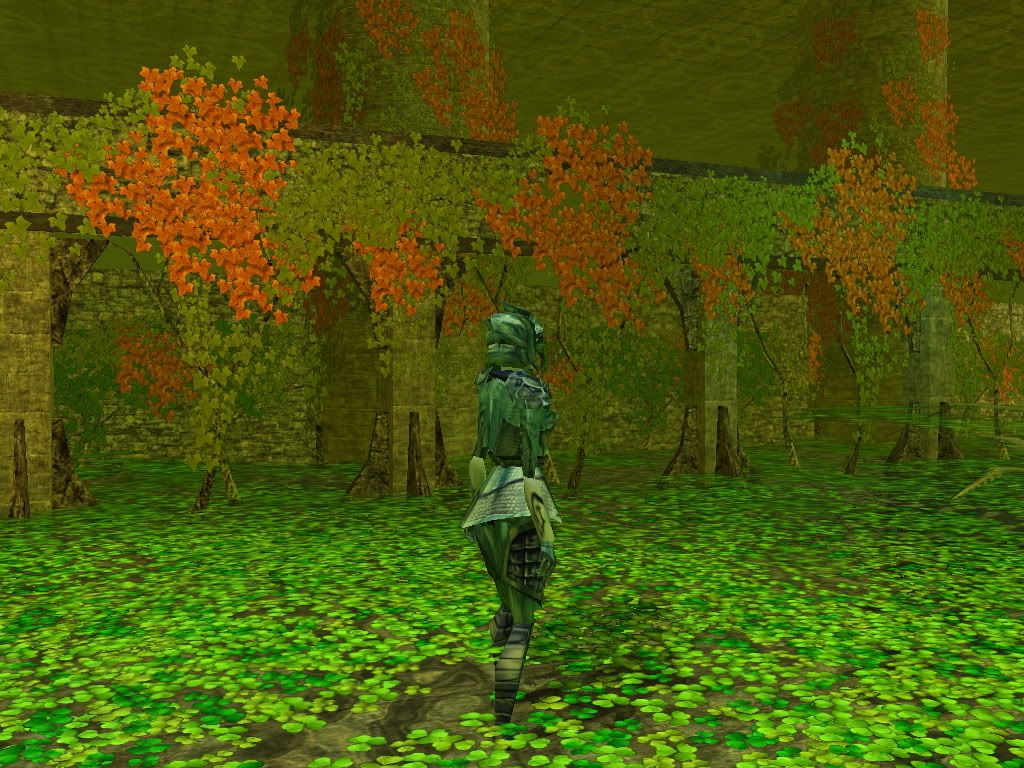
Subscribe to:
Posts (Atom)